
What is Java? A complete beginner’s roadmap to learn Java and get job ready — 2026

What is Java? How Java works (JVM, JRE, and JDK explained)
What is Java?
Java is a general purpose programming language designed to be secure, scalable, and platform-independent. It is widely used for building Java applications such as desktop software, web applications, enterprise-level systems, and even mobile applications through Android development.
Key features of the Java language include:
- Platform independence
- Strong memory management
- Object oriented programming design
- Extensive libraries and frameworks
- Support for building complex programs at scale
Java is a popular choice for organisations because it is stable, widely supported, and suitable for long-term software development.
How Java works
Java follows a unique execution process that makes it platform-neutral and efficient. Instead of running directly on the underlying platform, Java code runs through a virtual layer.
- JDK (Java Development Kit): A complete toolkit used by developers to write, compile, and run Java programs
- JRE (Java Runtime Environment): Provides the libraries and runtime required to execute Java applications
- Java Virtual Machine (JVM): Converts Java bytecode into machine-specific instructions
When you compile a Java program, it becomes bytecode. The Java virtual machine then runs that bytecode on your operating system, whether you are using a Windows machine or another environment. This is why Java is considered platform-independent.
If you have ever written a simple Hello World example, you have likely seen the entry point: public static void main. That is where the program starts executing. Every time you run Java, the JVM takes over and ensures the code works on the machine without needing platform-specific changes.
If JVM/JRE/JDK feels confusing, remember this simple line:
JDK = write + compile + run
JRE = run only
JVM = runs the bytecode
Java learning roadmap: How to become a Java developer
If you are wondering how to learn Java step by step, following a clear roadmap helps you stay focussed and job-oriented. A good roadmap ensures you learn Java basics first, then move towards real-world development.
Start by understanding Java syntax and core building blocks such as variables, data types, and control flow. Once that feels comfortable, move into object oriented programming, where you learn to create reusable blocks of code using classes, objects, and methods.
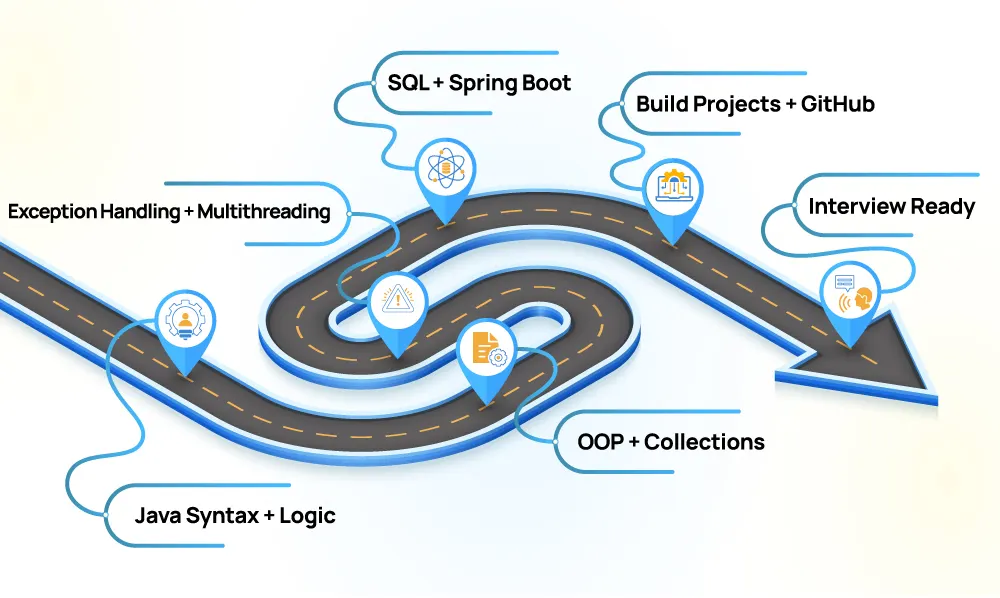
A structured path to becoming a Java developer
A practical Java learning roadmap includes:
- Learn basic syntax, variables, and data types
- Understand object oriented programming concepts
- Master exception handling and collections
- Explore frameworks and backend development
- Build real-world projects and practise coding
This sequence helps beginners move from fundamentals to professional-level Java development without confusion. It also helps you avoid a common mistake: trying to jump into advanced Java concepts without a strong base.
Core Java concepts you must learn to build a strong foundation
A strong grasp of core Java is essential before moving to frameworks, backend systems, or advanced Java. These fundamentals help you write clean, efficient Java code and build confidence in solving problems.
Core Java concepts to learn include:
- Data types and variables
- Control flow (loops and conditionals)
- Java arrays and basic data handling
- Object oriented programming principles (encapsulation, inheritance, polymorphism, abstraction)
- Java interfaces and abstraction design
- Exception handling and debugging
- Collections framework
- File handling and working with a Java file
- Java multithreading basics
Mastering these concepts gives you a solid foundation and prepares you for writing code that scales beyond small examples into real-world applications.
Programming languages and technologies to learn with Java
Java is powerful on its own, but modern development often involves combining multiple technologies. To improve employability, Java developers typically learn supporting tools that work well with Java.
Languages and technologies to learn with Java include:
- SQL for database management
- HTML, CSS, and JavaScript for web development basics
- Spring and Spring Boot for backend development
- REST APIs and microservices
- Cloud platforms and containerisation basics
- Build tools such as Maven or Gradle
These skills help you move from learning syntax to developing applications that can run in real production environments.
So what does this look like in real work? Let us break down the typical roles and responsibilities of a Java developer.
Essential skills required to become a Java developer
Technical knowledge alone is not enough. Employers want Java developers who can write clean code, solve problems, and work effectively in teams.
A strong Java developer skill set includes:
- Strong understanding of Java basics and core Java concepts
- Problem-solving and logical thinking
- Debugging and optimisation skills for high performance applications
- Knowledge of databases, APIs, and backend development
- Communication and teamwork abilities
- Hands on experience through projects and practice
If you want to present these skills in a recruiter-friendly way, refer to Top Skills Freshers Should Include in Their Resume, which helps align your technical and soft skills with hiring expectations.
So, what does a Java developer actually do in a typical software team?
Java developer roles and responsibilities
Understanding the roles and responsibilities of a Java developer helps you prepare for real-world expectations in software development. While responsibilities vary by company, most Java development roles involve designing, building, and maintaining applications.
The core responsibilities in Java development include:
- Designing and developing Java applications
- Writing clean, maintainable Java code
- Debugging and performance optimisation
- Collaborating with cross-functional teams
- Maintaining and updating enterprise applications
Across backend services, web applications, and Java Enterprise Edition systems, the goal is consistent: build reliable software that supports business needs.
The responsibilities stay the same, but the way you execute them depends on the tools you use every day.
Tools every Java developer must learn
Modern Java development relies heavily on tools that improve efficiency and collaboration. Using the right tools also helps you write tons of code faster, manage complex programs, and work smoothly in teams.
Essential tools include:
- IDEs like IntelliJ IDEA or Eclipse
- Version control systems such as Git
- Build tools like Maven or Gradle
- Debugging and testing tools
- Various tools for deployment and code quality checks
Familiarity with these tools ensures smoother development workflows and prepares you for professional environments.
Best Java projects for job readiness
Projects demonstrate practical knowledge, problem-solving ability, and real-world readiness. If you are following a Java tutorial, try to apply each concept into a small project instead of only reading examples.
Recommended Java projects for beginners include:
- Student management system
- Online banking application
- Library management system
- REST API-based application
A project becomes "resume-worthy" when it has:
- GitHub repo + README
- Screenshots / API documentation
- Clean folder structure
- Clear features (not just “CRUD”)
- Deployed link (if possible)
These projects strengthen portfolios and prepare candidates for interviews. Practising them also helps when reviewing Java Interview Questions and Answers, because you will understand concepts through real implementation, not memorisation.
Java career path after learning Java
Java offers multiple career paths depending on your interests and strengths. Many developers start with core Java, then progress into backend development or enterprise development.
Career options include:
- Java developer
- Backend developer
- Full-stack developer
- Software architect
- Technical lead
To position yourself effectively, explore Java Developer Resume Examples, and learn How to Write a Resume for Freshers to highlight projects, skills, and achievements clearly.
Java certifications that boost your career growth
Certifications validate skills and improve credibility, especially for beginners. They can also help you stand out when applying for roles in Java enterprise edition environments, backend teams, or web development roles.
Popular Java certifications include:
- Entry-level Java certifications for beginners
- Professional Java developer certifications
- Specialised certifications in frameworks and cloud
Certifications, combined with projects, improve job readiness and show commitment to continuous learning.
7-day Java job-ready sprint (quick boost)
| 📅 Day 1 | Revise Core Java + OOP |
| 📚 Day 2 | Collections + Strings |
| 🗄️ Day 3 | SQL + JDBC basics |
| 🔗 Day 4 | Build a REST API (Spring Boot) |
| 🛡️ Day 5 | Add validations + error handling |
| 💻 Day 6 | Push to GitHub + README |
| 🎯 Day 7 | Mock interview + revise weak topics |
Java gives you the foundation to write clean code, understand systems, and build applications that scale.
By following a clear roadmap and gaining hands-on experience, you can confidently move towards becoming a job-ready Java developer and grow into higher roles over time.
Frequently Asked Questions
Is Java good for beginners?
Yes. Java for beginners is ideal due to its structured syntax, strong community support, and extensive learning resources.
How long does it take to learn Java?
With consistent practice, basic Java can be learned in 2–3 months, while job readiness may take 6–9 months.
Can I get a job after learning Java?
Yes. With strong fundamentals, projects, and interview preparation, Java offers excellent job opportunities.
What should I learn after Java?
Frameworks like Spring, databases, and cloud technologies enhance career prospects.
Do I need a computer science background to learn Java?
No. You do not need a computer science degree to learn Java. Many successful Java developers come from non-technical backgrounds. With structured learning, consistent practice, and hands-on projects, beginners from any discipline can build strong Java programming skills.
Is Java still in demand in 2026 and beyond?
Yes. Java continues to be in high demand across industries such as finance, e-commerce, healthcare, and enterprise software. Its stability, scalability, and widespread use in backend systems ensure long-term relevance for Java developers.
What is the difference between Core Java and Advanced Java?
Core Java focuses on fundamentals such as syntax, object oriented programming, collections, and exception handling. Advanced Java builds on this foundation and includes topics like JDBC, servlets, JSP, Spring framework, microservices, and enterprise-level application development.
Can I learn Java online for free?
Yes. There are many free learning resources available, including documentation, tutorials, and coding platforms. However, combining free learning with a structured Java course, projects, and certifications can accelerate learning and improve job readiness.
How much coding practice is required to become job-ready in Java?
Daily practice is recommended. Spending at least 1–2 hours writing code consistently, along with building real-world projects, helps reinforce concepts and improve problem-solving skills.
Is Java used only for backend development?
No. While Java is widely used for backend development, it is also used in Android apps, desktop apps, enterprise applications, and large-scale distributed systems.
What are common mistakes beginners make while learning Java?
Common mistakes include skipping Java basics, memorising code without understanding logic, avoiding hands-on experience, and not practising debugging. Building a strong foundation in core Java concepts is essential to avoid these issues.
Should I learn Java before learning other programming languages?
Java is an excellent first language because it teaches strong programming fundamentals and object oriented principles. Learning Java first makes it easier to pick up other popular programming languages such as Python, C++, or JavaScript later.
How important are projects when learning Java?
Projects are crucial. They demonstrate practical skills, problem-solving ability, and real-world application of Java concepts. Recruiters often prioritise candidates with strong project portfolios over those with only theoretical knowledge.
What industries hire Java developers the most?
Java developers are hired across banking and financial services, IT services, e-commerce, telecom, healthcare, education technology, and enterprise software companies.