
Ultimate internship guide: Why you should do one and how to get started

Internships have become a crucial stepping stone in today’s competitive job market. Whether you are a student looking to gain hands-on experience, a recent graduate exploring career paths, or someone considering a career pivot, internships provide invaluable exposure to real-world scenarios. This guide will take you through everything you need to know, including why internships matter, how to apply for internship opportunities, and how to make the most of them to accelerate your career growth.
Table of Contents
1. What is an internship2. Why internships matter
3. Types of internships (modes and formats)
4. Top internship fields in demand
5. How to find internships (step-by-step)
6. When should you apply for internships
7. How to apply for an internship without experience
8. Paid versus unpaid internships: what is right for you
9. How to write a strong resume for internships
10. Skills required for internships (tech and non-tech)
11. What recruiters really look for in interns
12. Common internship mistakes to avoid
13. Frequently asked questions
What is an Internship
An internship is a structured, temporary work experience that gives students, recent graduates, or career switchers practical exposure to a specific industry or role. Unlike classroom learning, internships immerse you in real-world projects, team dynamics, and professional workflows, helping you understand how organisations operate.
Internships can range from a few weeks to several months and may be part-time, full-time, or remote. Depending on the field, interns may take on technical skills, content creation, research, or business development roles. Some internships offer financial compensation(paid internship), while others focus on providing experience, mentorship, and the opportunity to develop key skills.
Interns are expected to contribute meaningfully, take initiative, and learn through hands-on experience. These opportunities allow you to explore career interests, develop interpersonal skills, and build strong relationships with mentors and peers.
💡Pro Tip: Treat an internship as a bridge between academic learning and professional practice. It is your first opportunity to gain experience, apply theory to real work, and lay the foundation for future career goals.
Understanding what an internship entails is just the first step. The real power lies in why these experiences matter. They turn theoretical knowledge into tangible results, equip you with skills employers value, and accelerate your path from learning to doing.
Why internships matter
Internships are a gateway into the professional world, giving you a front-row seat to how industries operate and how teams achieve results. They allow you to move beyond theory and actively contribute to projects that create tangible impact.
Each internship is an opportunity to test your skills, understand workplace dynamics, and discover what drives you professionally.
Far from being a simple credential, internships help you understand the expectations of real work, navigate challenges, and adapt to diverse teams. They provide a safe space to gain hands-on experience, experiment with new ideas, and grow confidence in your soft skills and hard skills.
Whether you are coding a programme, running a marketing campaign, designing a product, or conducting research, internships immerse you in experiences that shape both your technical skills and interpersonal skills.
By the end of an internship, you gain clarity on your desired career path, a practical skill set, and relationships that can support your professional journey.
These are the key ways internships can accelerate your professional growth:
- Gain practical experience
Internships allow you to apply classroom knowledge to real-world scenarios, giving context to your learning and helping you develop skills that are in demand. You learn how to manage deadlines, prioritise tasks, and deliver tangible results. - Build a professional network
Interns interact with mentors, supervisors, and colleagues across teams. These professional relationships can guide your career decisions, provide references, and even connect you with potential employers. - Discover career interests
Experiencing multiple roles or related fields helps you identify your strengths and preferred career paths. This clarity prevents career missteps and accelerates long-term growth. - Increase employability
Employers value candidates with hands-on experience. Completing internships demonstrates initiative, reliability, and readiness to take on real responsibilities.To convert this experience into your first full-time role, check out our guide: How to prepare for a job interview. - Develop high-impact skills
Internships help cultivate communication, project management, logical reasoning, and technical skills that make you effective in both current and future roles. These abilities not only make you effective in your current role but also set the stage for higher-paying, high-responsibility positions.
Recognising the benefits is only the first step. Choosing the right type of internship ensures you gain the experiences that matter most for your goals.
Types of internships (modes and formats)
Internships come in different forms, each designed to provide valuable learning experiences while catering to your schedule, interests, and career goals. Understanding the formats available can help you choose the type that best aligns with your desired career path and overall career exploration.
- On-site internships: These traditional office-based roles provide direct exposure to workplace culture and team dynamics. They allow interns to build strong relationships, observe professional workflows, and gain hands-on experience in real-world scenarios.
- Remote internships: Flexible roles performed from home that involve collaboration with virtual teams. They help you strengthen communication, digital skills, self-discipline, and time management, while also allowing exposure to flexible hours and remote work experience.
- Part-time internships: Ideal for students or individuals balancing ongoing education or other responsibilities. They teach effective prioritisation and allow you to gain experience, develop soft skills and hard skills, and make informed decisions about future career paths.
- Full-time internships: Immersive internship opportunities where interns dedicate their entire working hours to projects. They provide accelerated learning, opportunities to take ownership of meaningful tasks, and hands on experience that helps with career development.
- Paid internships: Offer financial compensation alongside structured learning and clearly defined responsibilities. They often include mentorship, exposure to industry trends, and chances to develop key skills such as project management, business development, and account management valued by potential employers.
- Unpaid internships: Focus primarily on skills development, learning, and networking events. They are common in related fields like marketing, creative roles such as content creation, and non-profits where experience, building a portfolio, and career exploration are the main rewards.
Picking the right type of internship is important. The field you choose shapes the skills you gain and the doors that open. Let us look at the industries currently driving innovation and offering the most meaningful learning experiences.
Top internship fields in demand
Internships are available across a wide range of industries, but some fields consistently offer high-value internship opportunities that provide both learning and career growth. Choosing the right field early can help you gain relevant skills, build a professional network, and position yourself for future employment.
Here are some of the top sectors currently in demand:
Technology and IT: This field includes software development, data analytics, artificial intelligence, cybersecurity, and cloud computing. Interns gain hands-on experience with coding, system architecture, and emerging technologies, making them highly sought after by employers in today’s tech-driven world.
Digital marketing and social media: Roles cover SEO, content creation, analytics, and social media campaigns. Interns learn how to plan and execute campaigns, analyse audience engagement, and develop key skills in marketing strategies that attract potential employers.
Finance and consulting: Opportunities involve accounting, investment analysis, account management, and business development. Interns in this domain develop hard skills like financial literacy, analytical thinking, and logical reasoning that employers tend to value across related fields.
Engineering and design: Includes mechanical, civil, electrical engineering, as well as UX/UI and product design. Interns work on projects, gain experience with industry-specific tools, and develop technical skills while collaborating with a supervisor to meet real job requirements.
Healthcare and life sciences: Roles focus on research, laboratory work, clinical support, and healthcare administration. Interns conduct research, manage data collection, and assist in process workflows. This work experience provides a strong foundation for candidates pursuing scientific or clinical career paths.
Media and communications: Encompasses journalism, public relations, advertising, and copywriting. Interns focus on writing, communication, and content creation, while building a portfolio that demonstrates soft skills, creativity, and the ability to make a difference in audience engagement.
💡Pro Tip: Select internship fields that align with your long-term career ambitions and offer tangible skill development. Look for industries experiencing growth and innovation, as these provide greater exposure, mentorship opportunities, and potential for full-time roles.sw
Knowing which industries are growing helps narrow your focus, but turning that knowledge into the right opportunity requires a clear strategy.
How to find an internship (step-by-step)
Finding the right internship takes planning and focus. By following a clear approach, you can target opportunities that match your career goals, showcase your technical skills, and increase your chances of success.
- Identify your interests and career goals – Focus on industries and roles that excite you to ensure the internship aligns with your long-term plans. This is the perfect opportunity to think about your strengths and how they can serve your future ambitions.
- Research companies and programs – Look at company websites, job boards, and LinkedIn to search for openings and understand what each typical internship involves. Check details like organisation, location, and the kind of work experience offered, since these can vary depending on the company and field.
- Network actively – Attend webinars, interview prep sessions, join student forums, and connect with candidates, alumni, or mentors who can guide you or provide referrals. Building connections at the beginning of your career strengthens your ability to find the right job.
- Prepare your application – Tailor your curriculum vitae and cover letter for each role to highlight relevant hard skills, projects, and achievements. Strong writing and presentation skills show employers your readiness for real world scenarios.
- Apply strategically – Keep track of deadlines and submission requirements to avoid missing valuable internship opportunities. Prioritise both paid and full time roles that allow you to gain hands on experience and develop your professional profile.
- Follow up – Send polite, professional follow-ups to demonstrate interest and commitment. Consistency shows employers you are serious about completing the process successfully.
A well-planned search increases your chances, but timing determines whether you secure the most valuable positions.
When should you apply for internships
Timing plays a key role in securing the best internship opportunities. Different types of internships have specific application windows, and planning ahead ensures you do not miss out.
The table below outlines the ideal periods and typical durations for various internship types.
| Internship Type | Ideal Application Period | Duration |
|---|---|---|
| Summer | January to March | 6 to 12 weeks |
| Winter | September to November | 4 to 8 weeks |
| Semester-long | Prior semester start | 3 to 6 months |
| Rolling | Anytime | Varies |
💡Pro Tip: Start your search early. Competitive internships are often filled months in advance.
Even if you are just starting out, the right approach lets you demonstrate potential and readiness, proving that lack of experience is not a barrier.
How to apply for an internship without experience
Even if you have no prior professional experience, you can position yourself as a strong candidate by showcasing your potential and enthusiasm.
Here are some practical steps to help you get started:
- Highlight transferable skills – Emphasise abilities such as teamwork, communication, and problem-solving that are relevant across any role. Provide examples from group projects, class activities, or volunteer work.
- Showcase academic projects and volunteering – Demonstrate your initiative and learning by highlighting coursework, research, or community work where you contributed meaningfully.
- Create a mini portfolio – Compile samples of your work, such as design mock-ups, coding projects, blog articles, or campaign plans. This gives employers tangible proof of your abilities.
- Leverage your network – Reach out to professors, alumni, peers, or mentors who can recommend you, provide guidance, or refer you to internship opportunities.
You can also optimise your application by learning how to make your resume ATS friendly and following ATS resume tips for freshers, increasing the chances that recruiters notice your profile.
💡Pro Tip: Focus on what you can offer rather than what you lack. Showing curiosity, commitment, and the ability to learn quickly can make a strong impression.
Once you can position yourself effectively, the next choice is evaluating which opportunities deliver the best mix of learning, exposure, and growth.
Paid versus unpaid internships: what is right for you
Paid internships
When considering opportunities that also provide financial support, paid internships offer a structured environment to gain practical experience. They are ideal if you need an income during your internship or want measurable work experience that can be highlighted on your CV.
Often, these internships include clear responsibilities, mentorship, and performance evaluations. You can understand workplace expectations and demonstrate your impact on real projects, strengthening your profile for future roles.
Paid internships also help build professional habits such as time management, accountability, and reporting. They often serve as preparation for a successful interview with potential employers and can open doors to full-time positions.
Unpaid internships
For those focused on skill development and learning rather than immediate financial gain, unpaid internships provide valuable exposure. They are common in creative industries, start-ups, non-profits, or niche sectors where experience and hands-on involvement are highly valued.
These opportunities allow you to work on meaningful projects, experiment with new tools, and understand industry-specific workflows. Building a portfolio of real work and demonstrating initiative can be more valuable than monetary compensation.
Unpaid internships also help expand your professional network. Mentors and colleagues met during the internship can provide guidance, references, and support in securing future paid opportunities.
Regardless of whether an internship is paid or unpaid, the true value lies in the experience you gain. These opportunities allow you to sharpen your skills, contribute to real projects, and cultivate meaningful professional connections.
Evaluate each internship for the learning, exposure, and growth it offers, and select the one that best positions you for long-term career success.
💡Pro Tip: Prioritise internships that align with your career goals and growth potential. Look for experiences that expand your skill set and professional network, as these will have the most lasting impact.
After identifying the right internship, the key is showing recruiters your readiness through a resume that highlights both your capabilities and your potential to contribute.
How to write a strong resume for internships
A strong resume helps you stand out and demonstrates your readiness to contribute meaningfully. Focus on clarity, relevance, and measurable impact to catch recruiters’ attention, and refer to our internship resume format for freshers to structure yours effectively
- Clean and structured layout – Organise sections clearly for education, skills, projects, and work or volunteering experience. Use headings and bullet points to ensure your resume is easy to scan.
- Highlight relevant skills – Emphasise both technical and transferable skills. Include abilities like coding, design, or analytics alongside teamwork, communication, and problem-solving to show versatility.
- Quantify achievements – Whenever possible, add measurable outcomes. For example, “Managed social media campaign increasing engagement by 20 per cent” or “Reduced processing time by 15 per cent through workflow optimisation.”
- Tailor for each application – Adjust your resume to match the role and company. Use keywords from the job description and highlight experiences most relevant to the position.
- Keep it concise – Limit to one page, focusing on impactful experiences. Avoid unnecessary details that do not demonstrate value to the employer.
- Show initiative and professionalism – Include projects, volunteering, or side assignments that showcase your eagerness to learn and ability to take ownership.
Skills required for internships (tech and non-tech)
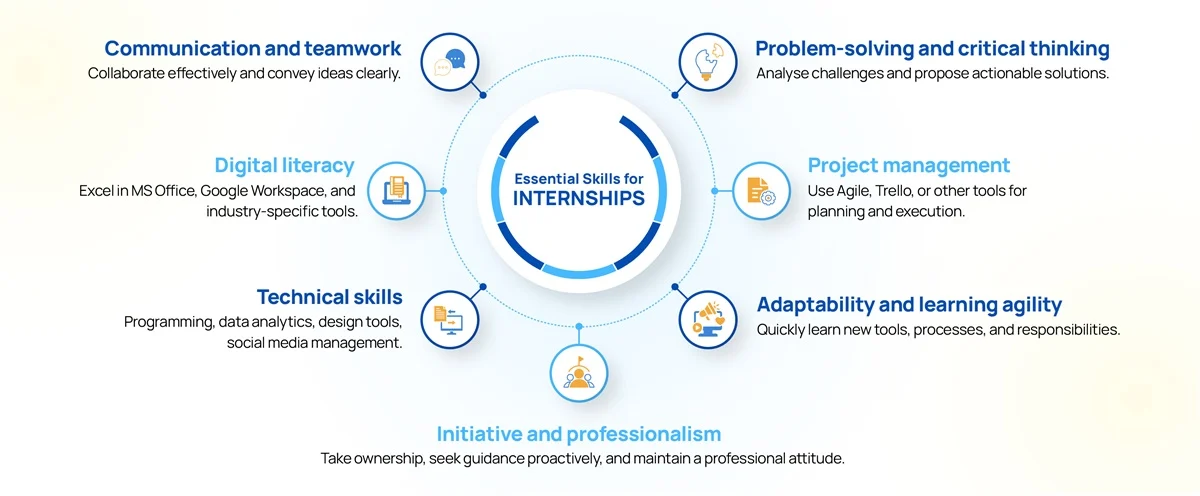
Internships are far more than a line on your CV. They are your chance to showcase capability, curiosity, and adaptability in real-world scenarios. While each internship comes with role-specific expectations, mastering a core set of hard skills and tech skills can help you stand out to recruiters, mentors, and potential employers.
To understand which skills will be most valuable in the years ahead, check out our guide on the most demanding skills in the future.
Communication and collaboration
Why it matters: Interns often work in teams, present ideas, and provide updates. Clear written and verbal communication ensures your insights are understood and acted upon.
How to develop: Participate in group projects, join discussion forums, or volunteer to present. Use concise, structured language in emails and reports.
Example: Explaining a digital marketing campaign idea to senior team members confidently and clearly in real-world scenarios.
Problem-solving and critical thinking
Why it matters: Employers value interns who can analyse challenges, propose solutions, and anticipate obstacles rather than simply follow instructions.
How to develop: Engage with real-world case studies, simulate projects, or tackle puzzles and coding challenges.
Example: Identifying bottlenecks in a workflow and suggesting a new tool or process to improve efficiency.
Technical and digital skills
Why it matters: In many fields, technical know-how is essential. Demonstrating that you can handle practical work from day one sets you apart.
Examples by domain:
- Tech/IT: Programming (Python, Java), data analysis (Excel, SQL, Tableau), cloud basics.
- Marketing: SEO, content creation, social media tools, Google Analytics.
- Design: Adobe Creative Suite, Figma, Canva, UX/UI prototyping tools.
Project management and organisation
Why it matters: Interns often juggle multiple tasks at once. Planning, prioritising, and meeting deadlines is essential for delivering results.
How to develop: Use tools such as Trello, Asana, or Jira for personal projects. Track tasks and progress systematically.
Example: Managing a mini-project for a campaign launch and delivering it on time using project management principles.
Adaptability and learning agility
Why it matters: Work environments change rapidly. Being able to learn new tools, processes, and responsibilities quickly is highly valued.
How to develop: Take short online courses, experiment with software, or volunteer for cross-functional tasks.
Example: Learning a new CRM tool in a week to support the sales team effectively.
Analytical and research skills
Why it matters: Many internships involve analysing data and gathering insights. Strong research and analytical skills help turn information into actionable recommendations.
How to develop: Work on data interpretation exercises, conduct mini research projects, or explore analytics dashboards.
Example: Preparing a competitor analysis report that informs a marketing strategy.
Initiative and professionalism
Why it matters: Interns who take ownership of tasks, seek guidance proactively, and maintain a professional attitude are more likely to secure full-time roles.
How to develop: Volunteer for extra tasks, ask thoughtful questions, and respect deadlines and workplace norms.
Example: Proactively suggesting process improvements rather than waiting to be assigned.
💡Pro Tip:The most valuable interns combine technical skills with interpersonal skills. This combination enables you to make meaningful contributions during your internship while signalling to employers that you are ready for greater responsibility and growth in related fields.
What recruiters really look for in interns
Recruiters seek interns who can contribute meaningfully from day one while showing the potential to grow within the organisation. Beyond technical knowledge, they value traits and behaviours that indicate readiness, professionalism, and adaptability.
- Initiative and eagerness to learn – Interns who proactively seek challenges, ask questions, and show curiosity make a strong impression.
- Ability to collaborate and communicate effectively – Clear communication and teamwork are crucial for contributing to projects, sharing ideas, and building relationships.
- Problem-solving and adaptability – Recruiters appreciate interns who can analyse issues, propose solutions, and adjust quickly to changing priorities.
- Relevant technical or soft skills – Demonstrating the skills required for the role, whether technical, analytical, or interpersonal, shows you can deliver value.
- Cultural fit and professional attitude – Reliability, respect for workplace norms, and alignment with company values help interns integrate and thrive in a professional environment.
Knowing what recruiters want helps you perform well, but avoiding common pitfalls ensures you maximise both learning and your professional reputation.
Common internship mistakes to avoid
Even small missteps during an internship application or tenure can affect your learning and future opportunities. Being mindful of these common mistakes helps you make the most of the experience and leave a positive impression.
- Applying without researching the company or role – Understanding the organisation, its culture, and the responsibilities of the role demonstrates seriousness and helps tailor your application.
- Submitting generic resumes or cover letters – Customising your documents for each opportunity shows attention to detail and highlights your fit for the position.
- Focusing only on salary rather than learning opportunities – Prioritising skill development and exposure ensures long-term career growth over short-term gains.
- Ignoring networking or mentorship opportunities – Building relationships with peers, mentors, and supervisors can provide guidance, references, and future career pathways.
- Overcommitting and missing deadlines – Taking on more than you can handle can hurt your reputation and prevent you from delivering quality work.
Even with preparation and awareness, questions will arise. Addressing common doubts gives clarity and confidence as you embark on your internship journey.
Turn internship experience into career opportunities with MyCareernet
Gaining hands-on experience through internships is only the first step. The real value comes when you connect what you have learned to the right opportunities. That is where MyCareernet can help.
As one of India’s leading career and job platforms, MyCareernet allows students and recent graduates to explore thousands of internships across industries including technology, digital marketing, finance, design and healthcare. The platform lets you:
- Match your skills and interests with curated internship opportunities
- Access detailed company insights and application guidance
- Stay updated on deadlines and recruitment trends
Register with MyCareernet early to explore internships and kickstart your career journey.
Frequently asked questions
Internships give you hands-on experience, help you understand workplace dynamics, and build skills that accelerate your career growth. They also increase your chances of securing full-time roles after graduation.
Apprenticeships are usually longer-term, paid, and structured training programmes focused on learning a trade or specific skill. Internships are short-term, learning-oriented experiences designed to provide exposure to a role or industry.
Aim for one to two substantial internships in your chosen field to gain depth. You can also explore shorter or exploratory internships to broaden your understanding of other areas.
Yes. Remote internships can provide hands-on projects, mentorship, and professional experience just like on-site internships, as long as you actively engage and learn from the opportunity.
No. Unpaid internships can still provide valuable experience, skills, and networking opportunities that strengthen your resume and open doors to future roles.
Real-world experience and demonstrable skills matter more than certificates. Employers value what you can do and the impact you can create over having a document of completion.
Yes, internships count as work experience if you can show measurable contributions and responsibilities undertaken during the period.
Many internships can lead to full-time roles, especially if you perform well, take initiative, and demonstrate alignment with the company’s culture and requirements.
Focus on your skills, projects, and problem-solving approach. Be ready to discuss your academic work, personal projects, and how you can contribute to the team.
Reflect on the experience, seek feedback if possible, improve your application materials, and continue applying. Persistence and continuous learning are key to securing the right opportunity.

MyCareernet
Author
MyCareernet brings expert insights and tips to help job seekers crack interviews and grow their careers.