
Top 10 high-income skills to learn in 2026

The job market in 2026 will be changing faster than ever, driven by automation, global competition, and emerging technologies. Whether you are a student preparing for your first role, a professional looking to grow, or someone considering a career switch, learning high-income skills is no longer just about earning more. It is about future-proofing your career and staying relevant in a world where change is constant.
Employers today are on the lookout for professionals with high-demand skills — from AI and data analytics to leadership abilities and other key skills that help drive innovation, improve efficiency, and even create entirely new opportunities. The ability to combine technical and soft skills and apply them effectively is what sets candidates apart and opens doors to career advancement.
In this guide, you will discover the 10 best skills to learn in 2026, complete with actionable tips to help you get started. You will also find guidance on choosing the right skill for your background and creating a plan for skill acquisition that maximizes your potential and positions you for success in the evolving job market.
Table of Contents
1. Why high-income skills matter in 20262. Top 10 high-income skills to learn in 2026
3. How to choose the right high-income skill based on your background
4. IT vs non-IT high-income skills: Which should you focus on?
5. Tips for mastering high-paying skills quickly
6. Frequently asked questions on high-income skills
Once your professional resume is ready, the next question is: where do you take it? That is where MyCareernet can help. From thousands of job openings to career path events and hiring contests, it gives you a stage to showcase your skills and land the opportunities you deserve.
Why high-income skills matter in 2026
The World Economic Forum predicts that by 2030, 170 million new jobs are expected to be created, while 92 million existing roles may be displaced by automation and emerging technologies. This dramatic shift means that the skills you invest in today will determine whether you thrive or fall behind in tomorrow’s job market.
High-income skills matter because they give you the ability to adapt, remain relevant, and take advantage of new opportunities. Professionals who can combine technical expertise with soft skills, like analytical thinking, problem-solving, and emotional intelligence will be the ones who not only survive but excel, creating impact in roles that may not even exist today.
💡Pro Tip: Never just learn a skill. Learn how it connects to business outcomes (e.g., how data science improves supply chain efficiency or how digital marketing drives customer acquisition). This is what makes you indispensable.
10 high-income skills to learn in 2026
Ready to stay ahead in your career? These 10 high-income skills — from AI and machine learning to digital marketing and project management — are shaping the opportunities of tomorrow. Explore them, see where your strengths fit, and discover which ones can accelerate your growth and impact.
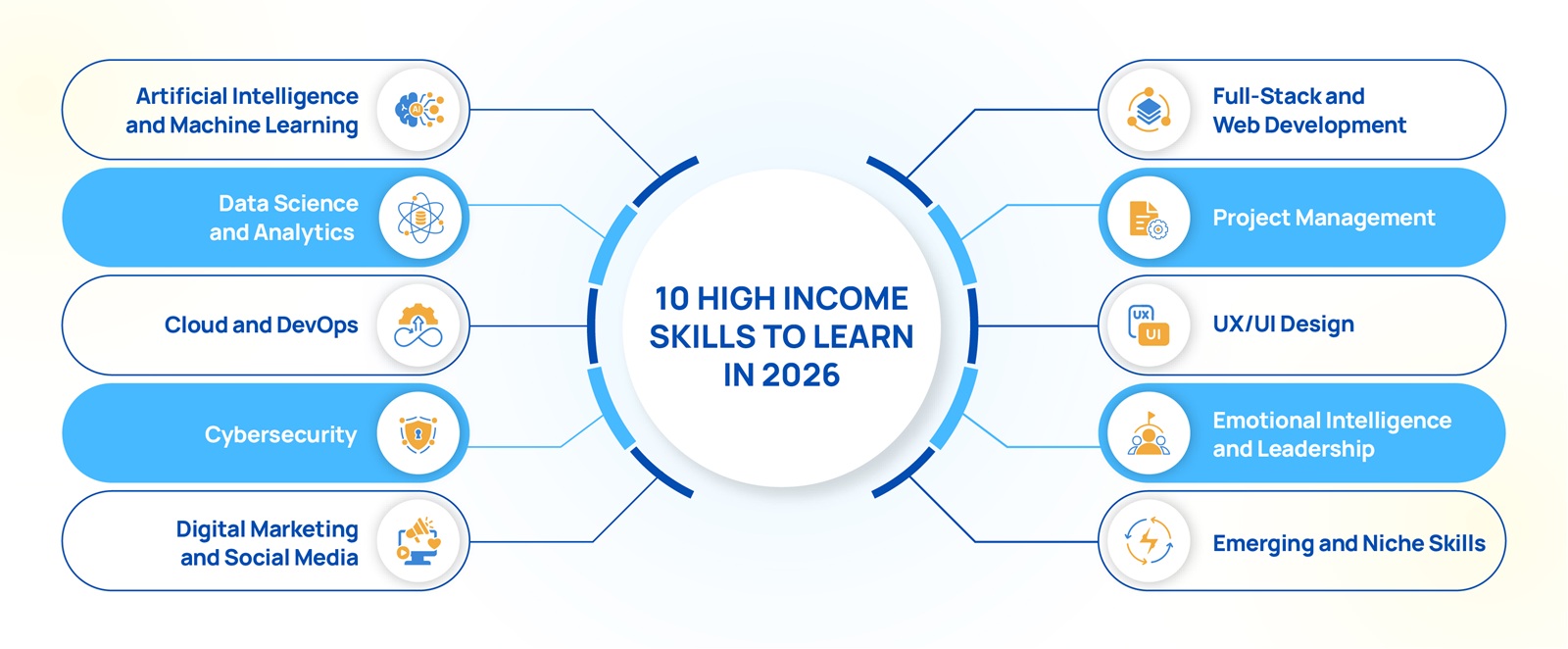
1. Artificial Intelligence (AI) and Machine Learning (ML)
AI and ML refer to technologies that allow machines to learn from data, recognise patterns, and make decisions with minimal human intervention. Think of ChatGPT, predictive analytics, image recognition, and autonomous systems.
Why AI and ML are in demand
AI and ML sit at the heart of digital transformation, powering high-paying roles in data science, natural language processing, robotics, and big data analytics. Today, AI has moved past being a future trend; it is an essential skill for anyone aiming to thrive in a digital-first organisation.
Professionals who master AI and ML do more than build machine learning algorithms; they know how to deploy them in real-world applications, combining technical expertise with soft skills to turn data into actionable insights and measurable business impact.
Best ways to learn AI/ML in 2026
- Micro-degrees on Coursera, edX, or Google AI
- Project-based learning (Kaggle competitions, open-source contributions)
- AI communities on LinkedIn or GitHub for mentorship and networking
High-paying AI/ML jobs
- Data Scientist
- AI Engineer
- Machine Learning Specialist
- NLP Engineer
AI/ML tools to know (and master)
Python, R, TensorFlow, PyTorch, Hugging Face, ChatGPT Prompt Engineering
💡Pro Tip: Pair technical mastery with business problem-solving. It is what distinguishes a high-income AI professional from a coder.
2. Data science and data analytics
Data science and analytics centre on turning raw information into actionable insights that drive smarter business decisions. It involves collecting, cleaning, and analysing large volumes of data — from building predictive models to creating clear visualizations using tools like Tableau and Power BI.
Why data science and data analytics are in demand
In 2026, businesses across industries (finance, healthcare, e-commerce, and manufacturing) will rely on data-driven decision-making to boost efficiency, improve customer experience, and drive growth.
But “big data” only becomes valuable when you can extract insights that matter. That is why, data analysis and modeling are among the most lucrative specialised skills today, and professionals who combine theoretical knowledge of statistics with hands-on tools empower leaders to make informed decisions faster.
Organisations are processing more data than ever before, and skilled professionals who can translate it into actionable insights will remain among the highest-paying and most in-demand roles.
Best ways to learn data science and analytics in 2026
- Online courses on Coursera, edX, and Google Data Analytics Certifications
- Hands-on projects working with open datasets on Kaggle to build your portfolio
- Specialising in a niche, like customer analytics, supply chain analytics, or green skills for sustainability
- LinkedIn groups and professional networks focussed on data skills and emerging technologies
High-paying data science and analytics jobs
- Data Scientist
- Data Analyst
- Business Intelligence Analyst
- Machine Learning Specialist
- Data Engineer
Data science and analytics tools to know (and master)
Python, R, SQL, Tableau, Power BI, Excel, Hadoop, Spark, Google BigQuery
💡Pro Tip: Pair your technical skills with data storytelling — the ability to “communicate effectively” with non-technical stakeholders. This rare skill significantly boosts your income potential.
3. Cloud computing and DevOps
Cloud computing delivers services like servers, storage, databases, networking, and software over the internet, while DevOps is a methodology and toolset that connects development and operations to deploy applications faster and more reliably. Together, they form the backbone of modern IT infrastructure.
Today, cloud roles go far beyond managing servers; they are about driving technological development at scale. Professionals who master AWS, Azure, or Google Cloud, along with DevOps tools such as Docker, Kubernetes, and Terraform, gain the programming skills to build, deploy, and secure applications efficiently, making them valuable contributors to job creation and digital transformation.
Why cloud computing and DevOps are in demand
Almost every business is moving to the cloud, and organizations are investing heavily in digital transformation, making cloud experts indispensable. When paired with DevOps automation, including CI/CD, containerisation, and infrastructure as code, cloud skills help teams accelerate project outcomes, reduce costs, and scale operations reliably.
This combination positions professionals for high-paying roles and, in many cases, six-figure salaries, making cloud computing and DevOps some of the most sought-after skills today.
Best ways to learn cloud computing and DevOps in 2026
- AWS, Azure, and Google Cloud official certifications
- Hands-on deployment of apps on cloud platforms
- Contribute to open-source DevOps projects to showcase your skills
High-paying cloud computing and DevOps jobs
- Cloud Solutions Architect
- DevOps Engineer
- Site Reliability Engineer (SRE)
- Cloud Security Specialist
Cloud computing and DevOps tools to know (and master)
AWS, Microsoft Azure, Google Cloud Platform, Docker, Kubernetes, Terraform, Jenkins, Ansible
💡Pro Tip: Combine cloud knowledge with cybersecurity to make yourself a one-stop solution for secure cloud deployments. All about cybersecurity below. 👇
4. Cybersecurity
Cybersecurity is all about keeping systems, networks, and data safe from digital attacks, unauthorised access, and evolving cyber threats. It spans a wide range of responsibilities, from ethical hacking and threat modeling to incident response and compliance management.
Why cybersecurity is in demand
With cyberattacks growing in frequency and sophistication, cybersecurity has become a non-negotiable business priority. Companies are investing heavily in experts who can protect sensitive data and ensure regulatory compliance.
The demand is for professionals who combine problem-solving skills with deep security knowledge. Roles like ethical hackers, security architects, and incident response specialists are essential for safeguarding intellectual property, maintaining customer trust, and keeping organizations resilient in an increasingly digital world.
Best ways to learn cybersecurity in 2026
- Security certifications, like CISSP, CompTIA Security+, Certified Ethical Hacker (CEH)
- Practice in virtual labs like TryHackMe or Hack The Box
- Staying updated on evolving cyber threats through forums and threat intelligence feeds
High-paying cybersecurity jobs
- Ethical Hacker Penetration Tester
- Security Architect
- Cybersecurity Analyst
- Incident Response Specialist
Cybersecurity tools to know (and master)
Wireshark, Metasploit, Splunk, Snort, Nessus, CrowdStrike, Palo Alto Networks
💡Pro Tip: Specialise in a cybersecurity vertical — finance, healthcare, or cloud security — to become the go-to expert for high-value clients.
5. Digital marketing and social media strategy
Digital marketing uses online channels (search engines, websites, email, and social media) to connect with audiences and drive results. Social media strategy focusses on building a strong brand presence and meaningful engagement on platforms like LinkedIn, Instagram, and X (Twitter).
Mastering these skills helps you turn insights into campaigns that deliver real business impact, making you an essential part of any organisation’s growth journey.
Why digital marketing and social media strategy are in demand
With AI-generated content flooding the web, businesses are seeking marketers who understand SEO, AEO (Answer Engine Optimisation), UX/UI for landing pages, and social media strategies that actually convert. These are among the most in-demand skills for the next 10 years.
Marketers who further combine these digital skills with customer relationship management insights can deliver personalised campaigns that drive engagement, improve user experience, and directly impact revenue.
Best ways to learn digital marketing and social media strategy in 2026
- Google Analytics, HubSpot, or Meta Blueprint certifications
- Hands-on projects, like managing ad campaigns or growing a real brand’s social presence
- Learning conversion copywriting and analytics for measurable results
High-paying digital marketing and social media strategy jobs
- Digital Marketing Manager
- Growth Hacker
- SEO/AEO Specialist
- Social Media Strategist
Digital marketing and social media strategy tools to know (and master)
Google Analytics 4, SEMrush, Ahrefs, HubSpot, Meta Ads Manager, Canva, Figma (for landing page design)
💡Pro Tip: Pair technical marketing skills with data analytics to deliver campaigns that are both creative and measurable.
6. Full-stack and web development
Full-stack development bridges front-end (user-facing) and back-end (server-side) programming, giving you the skills to build complete digital experiences. From websites and web applications to mobile apps and progressive web apps (PWAs), full-stack developers bring ideas to life across platforms.
Mastering these skills makes you a versatile professional who can design, develop, and deploy applications, positioning you for high-paying roles and opening doors to freelance opportunities, startups, and leading tech companies.
Why full-stack and web development are in demand
As businesses continue to embrace digital transformation, they need scalable, fast, and responsive web platforms. Full-stack developers who can manage the entire software development lifecycle are among the most sought-after and highest-paying professionals in tech.
Pairing these skills further with programming languages like JavaScript, React, and Python positions you for career advancement, giving you flexibility and high earning potential.
Best ways to learn full-stack and web development in 2026
- Mastering core languages: JavaScript, React, Node.js, Python, Go
- Building real-world apps for your portfolio
- Exploring mobile app development to broaden your earning potential
High-paying full-stack and web development jobs
- Full-Stack Developer
- Web Developer
- Mobile App Developer
- Software Engineer
Full-stack and web development tools to know (and master)
React, Angular, Vue.js, Node.js, Django, Flutter, GitHub, Docker
💡Pro Tip: Learn UX/UI fundamentals alongside coding (why: design-savvy developers earn more!).
7. Project management (Agile + digital transformation)
Project management is about planning, executing, and closing projects within time, scope, and budget. Today, with Agile methodologies and digital transformation, project managers do more than track timelines. They guide technology adoption and coordinate cross-functional teams to achieve meaningful results.
Successful project leaders combine management skills with technical and soft skills, enabling them to communicate effectively with engineers, stakeholders, and executives. Certifications like PMP or PRINCE2, when paired with digital literacy, accelerate skill development and position you for leadership roles.
Why project management is in demand
As organisations tackle increasingly complex, tech-driven projects, leaders who can deliver outcomes while managing risk are invaluable. Project management continues to be a high-income skill across industries, offering opportunities for career advancement and broader organisational impact.
Best ways to learn project management in 2026
- Certifications, like PMP, PRINCE2, and Certified ScrumMaster
- Leading small projects internally to build credibility
- Learning stakeholder communication and change management
High-paying project management jobs
- Agile Project Manager
- Program Manager
- Digital Transformation Lead
- Product Owner
Project management tools to know (and master)
Jira, Asana, Trello, MS Project, Miro
💡Pro Tip: Pair your project management credentials with a technical skill (like data analytics or cloud) to double your income potential.
8. UX/UI design
UX (User Experience) design focusses on how users interact with products, while UI (User Interface) design is about how products look and feel. Together, they create seamless and engaging digital experiences that delight users and drive business outcomes.
UX/UI professionals who understand user psychology and accessibility standards are in high demand across industries. This specialised skill helps you directly influence revenue, user retention, and customer satisfaction — key markers of a successful business.
Why UX/UI design is in demand
Every website and app out there is competing for user attention, and businesses are willing to pay premium rates for designers who can deliver conversion-focussed, accessible, and intuitive experiences. Professionals who master UX/UI design bring tangible value, making them essential to any digital-first organisation.
Best ways to learn UX/UI design in 2026
- Learning design tools, like Figma, Adobe XD, and Sketch
- Taking UX/UI bootcamps with real client projects
- Studying behavioural science and usability testing
High-paying UX/UI design jobs
- UX Designer
- UI Designer
- Product Designer
- Interaction Designer
UX/UI design tools to know (and master)
Figma, Adobe XD, Sketch, InVision, Hotjar, Miro
💡Pro Tip: Build a portfolio that highlights measurable results, like improved conversion rates or user satisfaction scores (not just pretty screens).
9. Emotional intelligence and leadership abilities
Emotional intelligence (EQ) is the ability to recognise, understand, and manage your own emotions and those of others. When paired with strong leadership abilities, it transforms good managers into exceptional leaders.
While technical expertise can get you hired, soft skills like empathy, communication, and adaptability are what help you get promoted and make an impact. In 2026, professionals who blend emotional intelligence with problem-solving skills will be driving innovation, team performance, and job creation.
Why emotional intelligence and leadership abilities are in demand
As automation reshapes the workplace, soft skills become a key differentiator. Abilities like EQ, creative thinking, communication, and leadership are among the most in-demand skills for the next decade, essential across industries for navigating complex challenges and leading teams to success.
Best ways to learn emotional intelligence and leadership abilities in 2026
- Leadership coaching or executive education programmes
- Active listening, feedback management, and conflict resolution
- Volunteering for team lead roles to build real-world EQ
High-paying jobs that involve emotional intelligence and leadership abilities
- Senior Manager
- Business Leader
- HR Director
- Change Management Specialist
Tools to master emotional intelligence and leadership abilities
Emotional Intelligence Assessments, Leadership 360 Feedback Tools, Coaching Frameworks
💡Pro Tip: Pair EQ with a high-demand technical skill; leaders who understand tech and people are the future’s top earners.
10. Emerging and niche skills (AR, green skills, prompt engineering)
Emerging and niche skills cover areas like Augmented Reality (AR), Virtual Reality (VR), green skills for sustainability, and prompt engineering for AI systems. These cutting-edge fields are seeing demand far outpacing supply, creating exciting opportunities for forward-thinking professionals.
The fastest-growing career paths will come from specialised skill acquisition in areas like augmented reality, sustainable design, or AI prompt engineering. These roles blend creativity, technological expertise, and business acumen, enabling you to shape entirely new markets and deliver measurable impact.
Why are niche skills in demand
Businesses are increasingly experimenting with immersive technology, sustainable supply chains, and AI-powered workflows. Professionals who master these future-ready skills position themselves as pioneers, commanding higher salaries, leadership opportunities, and a unique edge in the evolving job market.
Best ways to learn emerging and niche skills in 2026
- AR/VR development courses (Unity, Unreal Engine)
- Sustainability certifications (green supply chain, ESG)
- Hands-on prompt engineering with ChatGPT and other LLMs
High-paying jobs using emerging and niche skills
- AR/VR Developer
- Sustainability Consultant
- AI Prompt Engineer
- Innovation Manager
Tools to master emerging and niche skills
Unity, Unreal Engine, Blender, ChatGPT Prompt Engineering, Life Cycle Assessment Tools
💡Pro Tip: Do not wait for mass adoption. Early movers in niche skills often enjoy first-mover advantage and premium rates.
You have just seen the most in-demand and high-income skills that will shape 2026. But knowing what is out there is only half the equation.
The real challenge (and opportunity) is figuring out which skill is best for your future based on your strengths, interests, and career goals. And that is what we are about to explore next.
How to choose the right high-income skill based on your background
Choosing a high-income skill is not about chasing the latest trend; it is about aligning your natural strengths, industry context, and learning appetite with where the market is heading. A skill only becomes a career asset when it complements who you are and the problems you like solving. In detail, here is what you can do:
1. Map Your strengths to market needs
Start by understanding your core abilities. Skills that feel like an uphill battle won’t sustain you for the long run. Instead, pair what you are already good at with a high-demand area:
- Analytical thinkers thrive in AI/ML, data science, or cybersecurity, where pattern recognition and problem-solving are prized.
- Creative minds excel in digital marketing, social media strategies, or UX/UI design, where empathy and storytelling drive results.
- Leadership-oriented professionals fit naturally into project management, digital transformation, or even emerging tech leadership roles.
💡Pro Tip: Map skills to business outcomes (e.g., “I like analysing patterns” → “I will help businesses reduce costs with data analytics”). This makes your learning goal more concrete and marketable.
2. Look at industry trends and future demand
Your background matters, but so does where your industry is going:
- Tech graduates can lean into AI, cloud computing, or cybersecurity — fields where technical depth leads to premium pay.
- Non-tech graduates can build lucrative careers in digital marketing, project management, or UX/UI design, blending strategy with creativity.
The highest earners often sit at the intersection of disciplines, like AI-driven marketing, data-driven project management, or sustainable supply chain analytics. Do not limit yourself to “IT vs. Non-IT”; think hybrid.
3. Factor in lifelong learning (your “skill stamina”)
Some fields evolve faster than others. If you hate constant updates, cybersecurity or cloud might feel overwhelming. If you love tinkering with new tools, these fields may be energising.
Pick a skill where you are genuinely excited to stay current: reading whitepapers, attending webinars, experimenting with tools. This “skill stamina” ensures you not only acquire a skill but sustain it, making you valuable for years, not months.
💡Pro Tip: Think of your skill choice as a portfolio investment:
- Short-term payoffs: Pick a skill that can get you hired or freelancing fast.
- Long-term upside: Pick one that compounds with experience and tech advances (AI, green skills, prompt engineering).
By now, you have mapped your strengths, looked at industry trends, and identified the skills you are excited to master. But there is still one big decision point that can shape your income potential for years to come.
IT vs non-IT high-income skills: Which one should you focus on?
When people think of high-income skills, they often picture a clean split: IT skills like AI, cloud, cybersecurity, or programming on one side, and non-IT skills like digital marketing, emotional intelligence, or project management on the other. In reality, the future of work is not a tug-of-war; it’s a braid of tech and non-tech expertise.
- IT skills deliver high pay, deep specialisation, and global demand, but they require constant upskilling and a passion for solving technical problems.
- Non-IT skills also command premium pay and offer broader, faster entry routes, especially for professionals who excel at strategy, creativity, or people leadership.
Long story short: high pay and strong demand exist in IT, non-IT, and the powerful overlap between the two, depending on your strengths and interests. But information alone will not get you ahead. What separates the highest earners from the rest is how fast and effectively they turn knowledge into real capability.
Up next, we will explore practical, high-impact ways to master these skills quickly so you can shorten the learning curve and start seeing results sooner.
Tips for mastering high-paying skills quickly
Mastering high-income skills lies leaps and bounds beyond just “learning”. It involves engineering your learning for speed, depth, and impact. In 2026, attention spans will be shorter, industries will move faster, and employers will expect you to apply, not just absorb. Here is how to accelerate your path:
- Structured learning with real outcomes
No more binge-watching tutorials. Choose online courses and bootcamps with project-based outcomes — think Kaggle competitions for data science, AWS labs for cloud, or live campaigns for digital marketing. The goal is to have something tangible to showcase after each module. - Professional networks as accelerators
Join LinkedIn groups, Slack communities, hackathons, and niche forums where practitioners share real problems and solutions. Learning job skills alongside others doing the work dramatically cuts your trial-and-error time. - Portfolio > certificates
In 2026, employers will be drowning in certificates. What makes you stand out is a portfolio that proves you can execute — dashboards built in Tableau, apps deployed on GitHub, ad campaigns you have run, or UX mockups for real clients. This signals instant value. - Micro-specialise for higher pay
The market rewards specialists who solve specific problems, not generalists. Instead of just “data science,” think “data science for healthcare”, or rather than “AI,” think “AI for finance or supply chain.” Micro-specialisation also makes your learning journey clearer and faster.
Turn your new skills into high-income opportunities with MyCareernet
In 2026, the most valuable professionals will be those who blend technical expertise with soft skills and can show real business impact. Learning a skill is only half the journey — connecting it to the right opportunities is what makes it truly high income.
That is where MyCareernet comes in. As one of India’s leading career and job platforms, it lists thousands of roles from top employers actively seeking talent with skills like machine learning, project management, cloud computing, and digital marketing.
Create your MyCareernet account and match your new expertise to high-paying roles, access employer insights, and stay ahead of hiring trends.
Frequently asked questions about high-income skills
Certifications help validate your expertise and can open doors faster, but they are not mandatory. A strong portfolio, case studies, or hands-on project experience often speaks louder than certificates alone.
Depth comes first, breadth later. Begin by mastering one high-income skill thoroughly, then layer complementary skills to make yourself more versatile and valuable to employers.
A high-income skill is one that businesses are willing to pay a premium for because it drives revenue, efficiency, or innovation. Examples include AI/ML, data analytics, project management, UX/UI, and cybersecurity.
Skills that blend technology with human expertise, like AI, data science, cloud computing, digital marketing, and emotional intelligence, are set to stay relevant as industries evolve.
The “best” skill depends on your interests and strengths. If you are analytical, explore AI or data analytics. If you’re creative, try UX/UI or digital marketing. If you are leadership-oriented, focus on project management or emerging tech leadership.

MyCareernet
Author
MyCareernet brings expert insights and tips to help job seekers crack interviews and grow their careers.