Job interview tips that actually work: Insights from a leadership coach on how to crack interviews

Your heart is racing, your palms are clammy, and your mind is replaying every possible question. This is the reality of job interviews — whether you are a fresher wondering how to crack interviews for the very first time or a professional determined to avoid common interview mistakes from past experiences. The anxiety, the ambition, and the hope of being seen for who you truly are unite everyone who sits across that table.
And yet, interviews are not exams. They are stress tests of clarity, character, and composure. Recruiters can detect overconfidence in seconds and inauthenticity even faster. What separates the confident few from the rest is not polish, but preparation.
However, preparation does not mean cramming. It means building stories, signals, and confidence step by step. In this article, we walk through that exact sequence. Let’s go!
The insights in this article were first shared in Architects of Great Talent, the podcast series by the Careernet Group. In this episode, Priyadarshini Prabhu, People Director of Moss Adams India (now Baker Tilly), joined Neelabh Shukla, Chief Business Officer at Careernet, to discuss “The Code to Crack Job Interviews”.
Table of Contents
1. How to prepare for a job interview2. How to research a company before the interview
3. The role of mentoring and coaching in job readiness
4. Responding to difficult questions using the STAR method
5. How can you bring authenticity and competence to every job interview
6. How to say “I don’t know” confidently
7. What signals do recruiters notice beyond the resume
8. How does the “5Cs” framework shape hiring decisions
9. What are the dos and don’ts in an interview
MyCareernet is the go-to platform for job seekers to explore limitless opportunities—through hiring and prize contests, curated networking and career events, and thousands of openings from top employers. It connects preparation with real-world performance.
How to prepare for a job interview
Preparing for an interview centres on curating proof points, rehearsing delivery, and validating fit. Use the steps below as a checklist you can actually act on this week.
Step 1: Build proof of potential
Start by mapping two or three projects, internships, or coursework items to business outcomes (what improved, by how much, for whom). Do not only rely on what you put in the application form; come ready with stories that bring those points to life.
💡 Pro Tip: Always quantify the outcome in one line: “Reduced average response time by 18%” or “led a 4-person team to deliver X in 6 weeks.” As a fresher, if you have contest results or published work, talk about that.
Step 2: Rehearse delivery until it feels natural
Once you have proof, the challenge shifts to how you say it. Practise aloud, time your answers, and trim every filler sentence. Rehearsed answers are crisper and reduce rambling under pressure.
💡 Pro Tip: Record answers to a few common questions, then edit down until they convey the same point in 30–45 seconds each.
Step 3: Do some company intelligence
Preparation is incomplete without context. If you only polish your own story but know little about the company, you risk sounding generic. Dig into job postings, press releases, and even recent leadership moves. This research helps you connect your strengths to the current needs of your potential employer.
💡 Pro Tip: Write down a few questions related to the company’s recent business move and tie it to your role: “Your Q2 push into X — how will this role contribute to that outcome?
Want to go deeper? More on this below.
Step 4: Tailor your resume and your stories to the role
Finally, bring it all together. A tailored resume (or cover letter) is not a generic document with your dream job title. Read the job description thoroughly, pull 3 bullets from your experience that directly map to it, and rehearse telling those stories.
💡 Pro Tip: Put a one-line “impact banner” at the top of your resume/profile that mirrors the job’s top priority. That makes scanning recruiters interested.
How MyCareernet can help
- Participate in MyCareernet’s hiring challenges, hackathons, and prize contests. A concrete score, a placement on a leaderboard, or a challenge submission is far stronger than a line that says “familiar with X”.
- Use live job listings on MyCareernet to reverse-engineer role expectations and spot language (keywords) to mirror in your answers and resume.
- Network and meet mentors, alumni, and company reps at career events and fairs who can become long-term advisors.
These preparation steps give you a surface-level map of the role. Deep research is where you start drawing the finer details.
How to research a company before the interview
Superficial research is the fastest way to signal you are not serious about the interview. Recruiters call it a red flag because it shows up in your very first answers.
Instead, think like an insider. Your goal is not to memorise facts, but to show you understand where the company is headed and how the role connects to that journey.
Here is how to do it well:
- Scan press releases, the company website, and social media platforms to catch strategic moves — new markets, acquisitions, leadership hires.
- Pay attention to what the company calls their key priorities in their latest reports — that language is gold for tailoring your responses.
- Study competitors to understand positioning. If you know how rivals are expanding or struggling, you can frame sharper questions.
- Review interviewers’ LinkedIn profiles to anticipate their lens. A hiring manager with a finance background may probe differently than one with an operations background.
- Look at the company’s customer base (case studies, testimonials, reviews) to understand who they serve and what challenges they solve.
When you combine strong preparation with insider-level research, you not only answer questions better; you also ask sharper ones. But to deliver these under real interview pressure, you need practice.
The role of mentoring and coaching in job readiness
Even after a few interviews, most candidates realise that nerves (not lack of relevant skills) are what hold them back. Mentors and mock interviews give you that outside feedback loop, showing you how your interview skills actually land with others.
- Mock interviews stress simulations. Studies indicate that this kind of practice can lower anxiety and boost confidence by making the environment familiar before the actual interview.
- Coaches train you in active listening — the rarest but most decisive interview skill. Too many candidates miss the actual question and end up answering something entirely different.
- Mentors are your “personal board of directors”. These are the people you call before a big career leap — ex-managers, senior alumni, even a brutally honest peer. They challenge you and remind you to stay authentic when nerves tempt you to act like someone else.
💡 Pro Tip: When you do a mock interview with a mentor, ask them to interrupt you mid-answer with a curveball follow-up. If you can stay composed, adjust, and still land your point, you are interview-ready.
Mentoring builds resilience, but when the toughest interview questions hit, you still need to think on your feet and a structured way to respond. That is where you cue in the STAR method.
Responding to difficult questions using the STAR method
The STAR method is a straightforward way to keep your answers clear and credible, particularly when the interviewer asks about conflict, failure, or disagreement — topics that often trip up candidates who either speak defensively or jump too quickly to a “happy resolution”.
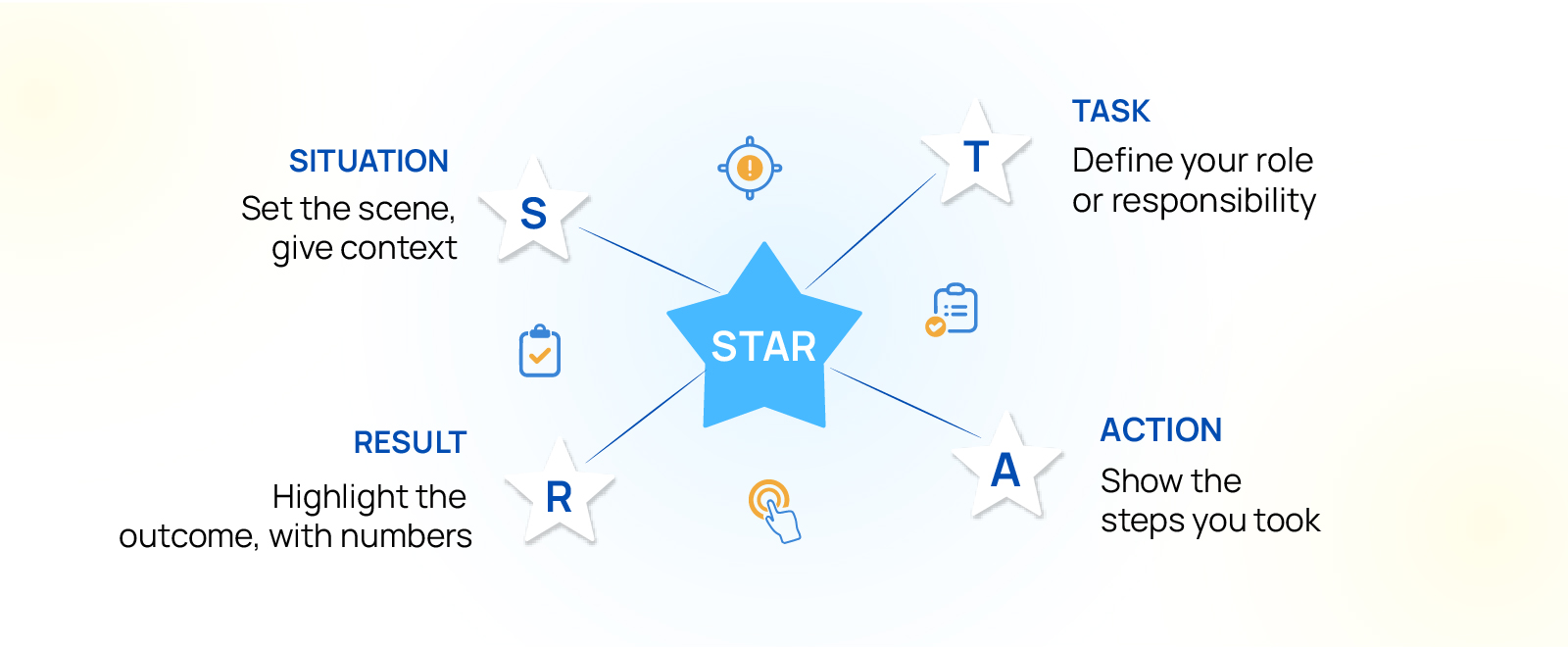
Used well, STAR turns messy interview experiences into clean narratives. It also shows maturity, because instead of avoiding your failures, you frame them around one clear idea: growth.
🧠 Example: Instead of saying “We had a conflict, but I solved it by communicating better,” try “In a project delay (Situation), my role was to realign the team (Task). I initiated a daily 15-minute stand-up (Action), which cut miscommunication and reduced delays by 20% (Result).”
And remember, your answers do not need to sound perfect. They need to sound real and flow like a conversation.
How can you bring authenticity and competence to every job interview
There is no mythical “ideal candidate”. Recruiters are not looking for a staged version of you — they expect the best real version. Competence gets you in the door; authenticity sets you apart.
Candidates who acknowledge gaps, draw on real experiences, and answer sincerely are the ones who consistently make the shortlist. And authenticity shows up most clearly when you do not have the perfect answer. Handled right, even “I don’t know” can work in your favour.
How to say “I don’t know” confidently
Few moments feel as high-stakes as not knowing the answer in an interview. Most people panic and start bluffing, but nothing erodes trust faster. Recruiters can sense fabrication almost immediately.
A more powerful move is to own the gap and redirect it into curiosity. For example: “I do not know, but I would be eager to learn how your team approaches it.” This signals integrity, humility, and the ability to learn on the job (qualities managers value more than a rehearsed but hollow response).
The small choices you make in moments of uncertainty — pausing, asking clarifying questions, admitting limits — send strong signals about how you operate. These cues matter just as much, if not more, than the credentials listed on your resume.
What signals do recruiters notice beyond the resume
Recruiters notice much more than degrees or academic certificates. Certifications may get you through screening filters; they prove baseline knowledge. But they rarely win offers.
Recruiters pick up on subtle cues that reveal your maturity, potential, and lived success:
- Consistency between resume and story: If your resume says you “led a project,” but your story suggests you were a participant, credibility takes a hit.
- Emotional tone: Candidates who can describe challenges without sounding bitter or defensive show resilience and professional maturity.
- Follow-through: Most interviewers notice if you revisit a question you struggled with earlier (it signals reflection and adaptability).
- Genuine curiosity: Asking questions that connect dots, rather than filling silence, demonstrates engagement and insight.
These cues can feel intangible, but recruiters process them systematically. In fact, they often use a mental framework — the 5Cs — to weigh candidates holistically.
How does the “5Cs” framework shape hiring decisions
Recruiters rarely rely on a single factor when deciding who moves forward. More than qualifications and correct answers, they subconsciously filter candidates through the 5Cs framework — a personality shorthand for whether someone is truly hireable:
- Character: Integrity, sincerity, and how you behave under pressure. Are you respectful, honest, and trustworthy?
- Competence: Your technical and analytical skills, and ability to do the job today
- Culture fit: Whether your working style complements the team’s values and rhythm
- Communication: Not only fluency, but clarity, structure, and — most importantly — listening
- Career direction: Whether your goals align with the company’s trajectory, or if you are likely to churn in a year
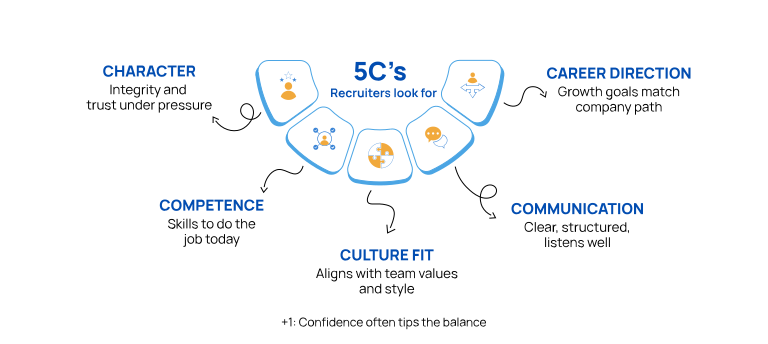
A sixth C often sneaks into the equation: Confidence. Not bravado, but the calm assurance that you can handle complexity without arrogance.
What makes the 5Cs powerful is that they are interdependent. For instance, competence without character makes recruiters nervous. Character without communication leaves doubts. Confidence without competence rings hollow.
Interviewers measure how balanced these Cs are in every response you give, which means your dos and don’ts matter even more.
What are the dos and don’ts in an interview?
The interview process is not a checklist of right and wrong moves, but certain behaviours consistently tilt the scales between you and other candidates. Whether you are attending online or invited to an in-person interview at an assessment centre, recruiters notice these almost subconsciously.
Do:
- Arrive early. First impressions form within seconds, and punctuality signals respect.
- Tailor responses to the role. Weave in language from the job description to show you understand what matters most.
- Ask thoughtful, business-linked questions. Questions that tie back to the company’s strategy are remembered long after you leave the room.
- Show genuine enthusiasm. Energy in your tone, body language, and curiosity signals motivation.
Do not:
- Criticise previous employers. Even if justified, it raises doubts about your professionalism.
- Ramble. Brevity shows clarity; long-windedness looks like insecurity.
- Excuse lateness with clichés. Arriving late and pitching “traffic” and “connectivity issues” make you seem unprepared.
- Slouch, cross arms, or avoid eye contact. Recruiters trust non-verbal cues as much as verbal ones.
Take your job interviews to the extra mile with MyCareernet
Now that you know how to prepare, research, practise, and present yourself authentically, MyCareernet helps you turn knowledge into action. The platform allows you to practise in real-world scenarios, connect with mentors and recruiters, and showcase verified proof points that make your achievements tangible.
Sign up on MyCareernet for free and make your next interview the one when you leave a lasting impression.

MyCareernet
Author
MyCareernet brings expert insights and tips to help job seekers crack interviews and grow their careers.