
Java Developer resume examples: Fresher to experienced level

Importance of a well-structured resume for Java developer roles
The Java programming language continues to power large-scale enterprise systems across industries, which also means every Java role attracts intense competition. When dozens (or hundreds) of Java developer resumes look similar, structure becomes your advantage.
A well-structured resume for Java developer fresher and experienced, helps you:
- Surface relevant technical skills (Java, Spring Boot, databases) instantly
- Align with Applicant Tracking Systems (ATS) keyword scanning and filters
- Make your Java developer experience easy for recruiters to evaluate
A strong resume goes beyond listing technical skills or programming languages. It clearly demonstrates:
- Technical expertise across Java, Spring framework, and backend development
- Real-world experience through projects, roles, and measurable outcomes
- Sets you apart from similar profiles by presenting your strengths and achievements in a focussed, organised way
If your Java developer skills, Java frameworks, or key projects are not visible in the top half of page one, the resume is usually skipped. Structure is not about design — it is about clarity and hierarchy.
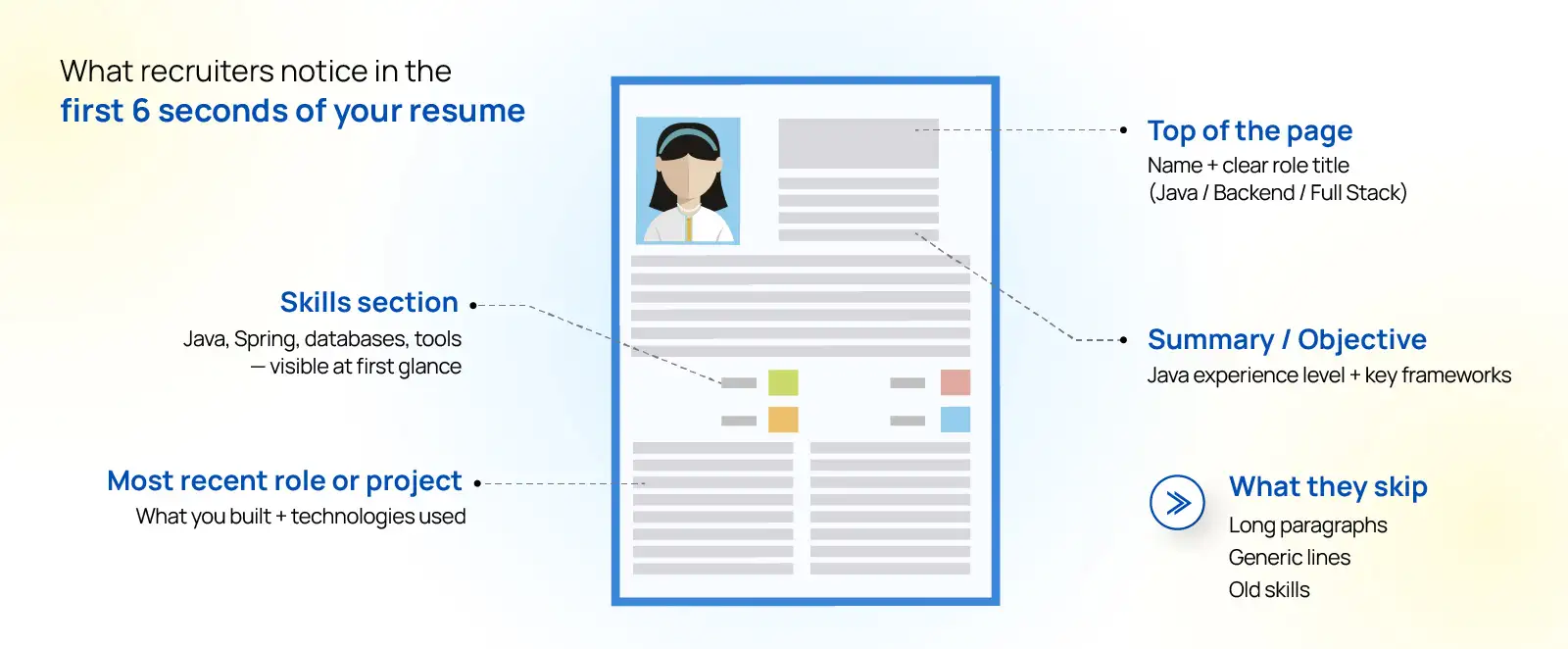
The 6-Second Rule: What recruiters notice when scanning your Java resume
Resume format for Java developers
For most roles, from entry-level Java developer to senior Java developer, the reverse-chronological resume format is a recruiter-friendly choice.
Reverse-chronological resume (recommended)
It highlights your most recent experience first, helping recruiters quickly assess your current skills and career progression.
Who should use it:
- Experienced Java developers
- Professionals with consistent work history
- Candidates applying to mid or senior roles
- Freshers, showcasing their Java understanding
Why it works:
- Highlights recent Java programming and backend development work
- Shows progression across junior developers to senior developers
- Convenient for ATS and hiring managers to scan
This is the format most hiring managers expect — and trust.
How to write a professional summary
Java developer resume summary (for experienced professionals)
The summary for a Java developer resume is ideal if you have work experience. It should briefly highlight:
- Years of experience
- Core Java skills and frameworks
- Type of applications you have worked on
Results-driven Java Developer with 7+ years of experience building scalable Java applications using Java and Spring Boot. Proven track record of delivering performant backend systems, collaborating with cross-functional teams, and optimising application performance in enterprise environments.
Java developer resume objective (for freshers)
Freshers should use an objective instead of a resume summary. This focusses on:
- Your foundation in Java
- Your learning mindset
- Your career intent
Best for junior Java developer resumes and entry-level Java developer roles.
Detail-oriented Java developer with a strong foundation in computer science, object-oriented programming, and Java programming language, seeking an entry-level role to contribute to backend and full-stack development projects.
🎯 Tip: Avoid career goals like “seeking growth”. Focus on the value you bring.
Java developer resume examples – fresher level
In a resume for a Java developer fresher or junior developer, potential matters more than experience.
Your resume should emphasise:
- Java fundamentals
- Academic and personal projects
- Internships, bootcamps, certifications
What to include prominently:
- Core Java, OOPs, Collections
- Mini projects with real logic
- Tools like Git, MySQL, and Maven
Example project bullet:
Developed a Java-based employee management system using JDBC and MySQL, implementing CRUD operations and basic authentication.
Java developer resume examples – experienced level
Experienced resumes are evaluated on impact, scale, and ownership. These include mid-level Java developers, senior developers, Java full stack developers, and more.
Focus on:
- What systems did you work on
- Technologies used
- Results delivered
- Designed and maintained Spring Boot microservices serving 1M+ users
- Reduced API response time by 35% through query optimisation and caching
💡 Tip: If it did not change performance, cost, scale, or reliability — rewrite it.
Key sections to include in a Java developer resume
A strong Java developer resume should always include:
- Professional summary/objective
- Technical skills (clearly grouped)
- Experience or projects
- Education
- Certifications or training
Optional but powerful sections include:
- GitHub / portfolio links
- Open-source contributions
- Hackathons or coding competitions
📌 Every section should answer: “How does this help me hire you?”
Java developer roles and responsibilities in a resume
Instead of listing generic responsibilities, write achievement-oriented bullets. Keep bullets concise using the formula: Action verb + tech + outcome.
| ❌ Avoid | ✅ Write |
|---|---|
| Responsible for backend development | Developed Java-based backend services using Spring Boot and REST APIs |
| Worked on improving speed | Implemented multithreading to improve system throughput |
| Talked to frontend team | Collaborated with frontend teams for seamless API integration |
Must-have skills for a Java developer resume
📌 Only list skills you can defend in an interview.
- Core Java skills: Java, OOPs, Collections, Multithreading
- Backend development: REST APIs, JVM fundamentals
- Frameworks and tools: Spring Boot, Spring MVC, Hibernate, Maven, Git, Jenkins
- Databases and systems: MySQL, PostgreSQL, NoSQL basics, Microservices fundamentals
Sample resume templates for a Java developer
Below are responsive, ready-to-use resume structures that you can adapt for your own job applications.
Fresher level
Rahul Sharma
Java Developer | Bengaluru, India
📧 name@email.com | 📞 +91-9XXXXXXXXX | 🔗 GitHub: github.com/username | 🔗 LinkedIn: linkedin.com/in/username
Motivated Java developer with strong fundamentals in Core Java, object-oriented programming, and data structures. Seeking an entry-level Java developer role where I can apply academic knowledge and hands-on project experience to build scalable, real-world applications while continuing to learn industry best practices.
- Programming language: Java
- Core concepts: OOPs, Collections, Exception Handling, Multithreading
- Frameworks: Spring Boot (basic), JDBC
- Databases: MySQL
- Web technologies: HTML, CSS (basic understanding)
- Tools: Git, GitHub, Eclipse, IntelliJ IDEA
- Concepts: REST APIs, MVC architecture
- Developed a console-based Java application to manage student records, including creation, update, and deletion of data.
- Implemented JDBC for database connectivity and CRUD operations.
- Improved data accuracy by validating inputs and handling exceptions effectively.
- Built REST APIs for account creation, balance inquiry, and fund transfers.
- Used Spring Boot to structure business logic and controller layers.
- Tested endpoints using Postman and handled error scenarios gracefully.
- Gained hands-on experience in Core Java and Spring Boot through guided projects.
- Java Programming Certification – XYZ
- SQL for Developers – XYZ
Experienced level
Amit Verma
Senior Java Developer | Pune, India
📧 name@email.com | 📞 +91-9XXXXXXXXX | 🔗 GitHub: github.com/username | 🔗 LinkedIn: linkedin.com/in/username
Results-driven Java Developer with 7+ years of experience in designing, developing, and maintaining enterprise-grade applications. Strong expertise in Java, Spring Boot, microservices architecture, and RESTful APIs. Proven ability to deliver scalable, high-performance solutions while collaborating with cross-functional teams.
- Programming languages: Java (8, 11, 17)
- Frameworks: Spring, Spring Boot, Hibernate, JPA
- Architecture: Microservices, RESTful APIs
- Databases: MySQL, PostgreSQL, MongoDB
- Cloud & DevOps: AWS (EC2, S3), Docker (basic)
- Tools: Git, Maven, Jenkins, IntelliJ IDEA
- Testing: JUnit, Mockito
- Designed and developed scalable backend services using Java and Spring Boot for high-traffic enterprise applications.
- Built and maintained microservices handling over 1M+ transactions per day.
- Improved application performance by 35% through query optimisation and efficient caching strategies.
- Developed RESTful APIs using Spring MVC and Hibernate for business-critical modules.
- Integrated relational databases using JPA and optimised SQL queries.
- Developed backend services for order processing, payment handling, and inventory management.
- Ensured secure API communication using authentication and authorisation mechanisms.
- Oracle Certified Professional: Java SE Programmer
- Spring Framework Certification
Resume writing tips for Java developers
A strong resume reflects the same principles as good Java code — clarity, structure, relevance, and purpose. It should communicate competence without noise and depth without complexity.
If you are early in your career, align your resume with a well-defined Java learning roadmap, highlighting skills and projects as you progress from fundamentals to real-world Java applications.
| Resume Insight | What Hiring Managers Look For |
|---|---|
| Customise for every role | Tailor your resume for every application by aligning your skills. Include the best Java projects for resume and experience with the specific role. |
| Balance technical and soft skills | Use relevant keywords and phrases from the job description — especially for technical and soft skills, tools, and frameworks. |
| Demonstrate results and outcomes | Quantifying achievement, such as improvements in performance, efficiency, or delivery. |
| Keep it ATS-friendly | Write concise bullet points with short line lengths to make your resume easy to scan. |
| Provide links to your work | Include links to GitHub repositories, portfolios, or live projects if applicable. |
| Be concise | Aim for a one-page resume if you are early in your career, and up to two pages if you have substantial professional experience. |
Optimisation tips for ATS for a Java developer resume
You might have the right Java skills, projects, and experience — but if your resume is not ATS-friendly, it may never reach a recruiter. Understanding how ATS screening works is the first step to making sure your resume gets seen.
What ATS systems scan for
ATS platforms primarily look for:
- Job title relevance (for example, Java Developer, Java Full Stack Developer)
- Skills frequency and relevance across the resume
- Clear section headers that help classify information
If these elements are unclear or missing, your resume may be filtered out even if you are technically qualified.
Use standard section headings
Always use commonly recognised section titles such as Professional summary, Technical skills, Experience, and Education. Standard headings help ATS correctly identify and categorise your information. Creative or unconventional headings can reduce parsing accuracy.
Be explicit with technologies and versions
ATS systems respond better to specific, clearly stated technologies rather than broad or vague descriptions.
Instead of: "Worked with modern Java"
Write: "Worked with Java 11, Spring Boot, and REST APIs"
Mentioning specific Java versions (Java 8, 11, 17, 21), frameworks, and tools improves keyword matching.
Follow ATS-friendly formatting practices
To ensure accurate scanning:
- Use a single-column layout
- Avoid tables, graphics, icons, or text boxes
- Use standard fonts and spacing
- Submit a PDF or DOCX format. Avoid formats that may not be compatible.
Maintain consistency in language and formatting
Consistency helps ATS systems correctly map your information. Use the present tense for current roles and the past tense for previous roles. Keep bullet points, dates, and headings uniform. Use the same terminology for skills across sections.
Common mistakes to avoid
Even a strong resume can fall short because of a few simple missteps. Think of these as quick fixes — clean them up, and your resume instantly reads better.
- Writing long paragraphs: Resumes are not essays. Long blocks of text are hard to scan and easy to skip. Keep points short, clear, and focussed — one idea per line works best.
- Listing outdated or irrelevant skills: More skills do not always mean a better resume. Listing tools you no longer use or skills unrelated to the role can dilute your profile. Stick to relevant skills.
- Copy-pasting job descriptions: Recruiters can spot this instantly. Copy-pasted responsibilities or job descriptions sound generic and say little about your contribution. Write in your own words.
- Missing GitHub or project links: For Java developers, proof matters. Not mentioning GitHub or project links is a missed opportunity to show how you code, structure solutions, and solve problems.
- Using generic resume summaries: Phrases like “motivated Java developer” do not set you apart. Use your summary to quickly state what kind of Java work you do and where your strengths lie.
Ask someone to scan your resume for 30 seconds and answer: "What kind of Java developer is this?" If the answer is unclear, your resume needs sharpening.
Frequently Asked Questions
How long should a Java Developer's resume be?
For freshers and early-career developers, a one-page resume is ideal — it forces clarity and focus. Experienced Java developers can extend to two pages, provided every section adds clear value and relevance.
What is the best resume format for a Java Developer?
The reverse-chronological format works best. The Java developer resume template highlights your most recent experience or projects first, making it easier for recruiters and ATS systems to assess your current skills and role fit.
Should I list Java versions (Java 8, 11, 17, 21) on my resume?
Yes. Listing Java versions is highly recommended, especially when the role specifies a particular version. It signals practical exposure and helps your resume match ATS keyword filters.
What technical skills should I highlight on a Java resume?
Focus on skills that reflect real-world application, such as Core Java, Spring Boot, REST APIs, databases, version control tools, and basic system design concepts. Prioritise relevance over listing every tool you’ve encountered.
Should I add personal or open-source projects?
Absolutely. Projects demonstrate hands-on ability, initiative, and problem-solving skills — especially valuable for freshers or candidates transitioning roles. Whenever possible, include links to code repositories.
How do I quantify achievements on a Java resume?
Use metrics to provide context and impact. This could include performance improvements, reduced processing time, increased system efficiency, or the scale of users or data handled. Even approximate numbers add credibility.
Are certifications important on a Java resume?
Certifications can strengthen your profile, but they are not a substitute for practical experience. Recruiters typically value projects and real-world applications more than certificates alone.