
How to Become a Data Analyst in 2026: Complete Beginner Roadmap

A college fest gets fewer registrations than expected. A placement drive sees lower turnout. An Instagram page suddenly stops growing. The numbers exist, but the reason behind them is unclear when teams look only at raw data. This is often where structured data analysis becomes necessary.
A data analyst helps connect those dots.
At its core, a data analyst’s job is to look beyond spreadsheets and dashboards and understand what the data is actually saying. They study patterns, spot changes, and explain why something worked one month and failed the next by applying analytical thinking and data analysis techniques. The role is less about staring at numbers and more about solving problems using data.
Most data analysts work on collecting data, handling raw data, performing data cleaning, analysing trends, and presenting data insights in a way that non-technical teams can understand. This supports data-driven decisions across teams, where curiosity and logical thinking matter more initially than advanced tools.
In this article, you will learn how to build the right skills, choose the right tools, and follow a detailed data analyst roadmap to start your career as a data analyst.
📌 Did you know?
Many entry-level data analyst roles do not require a computer science degree. Recruiters often prioritise problem-solving ability, comfort with numbers, and hands-on projects over formal qualifications, especially in a competitive job market.
Table of Contents
1. Complete data analyst roadmap (step-by-step sections)2. What does a data analyst do?
3. Common mistakes freshers make when learning data analytics
4. Practise with real datasets
5. Build a data analyst portfolio and create a job-ready resume
6. Recommended certifications and courses
7. Prepare for interviews
8. Apply for internships and entry-level jobs
9. Career paths after becoming a data analyst
10. How long does it take to become a data analyst?
11. Take the first step towards your data analyst career with MyCareernet
Complete data analyst roadmap (step-by-step sections)
For students and freshers, one of the biggest challenges is knowing where to start. A quick search brings up countless tools, courses, and certifications, making the data analyst journey feel overwhelming.
A clear data analyst roadmap brings structure to that confusion. Instead of learning tools randomly, it shows how to become a data analyst step by step, starting with fundamentals and moving into the core tools required for entry-level roles.
This approach aligns with real-world data analyst job qualifications, which prioritise analytical thinking, essential skills, and practical exposure over theory. For freshers, eligibility to enter data analytics is flexible.
Most companies look for comfort with numbers, problem-solving ability, familiarity with common data analyst tools, and the ability to analyse data, rather than a formal computer science degree.
This data analyst roadmap for freshers helps build confidence gradually without skipping foundations that support long-term growth.
📌Who is this roadmap for?
This roadmap is designed for students, freshers, and early-career professionals with little or no prior analytics experience. You do not need a technical degree to get started.
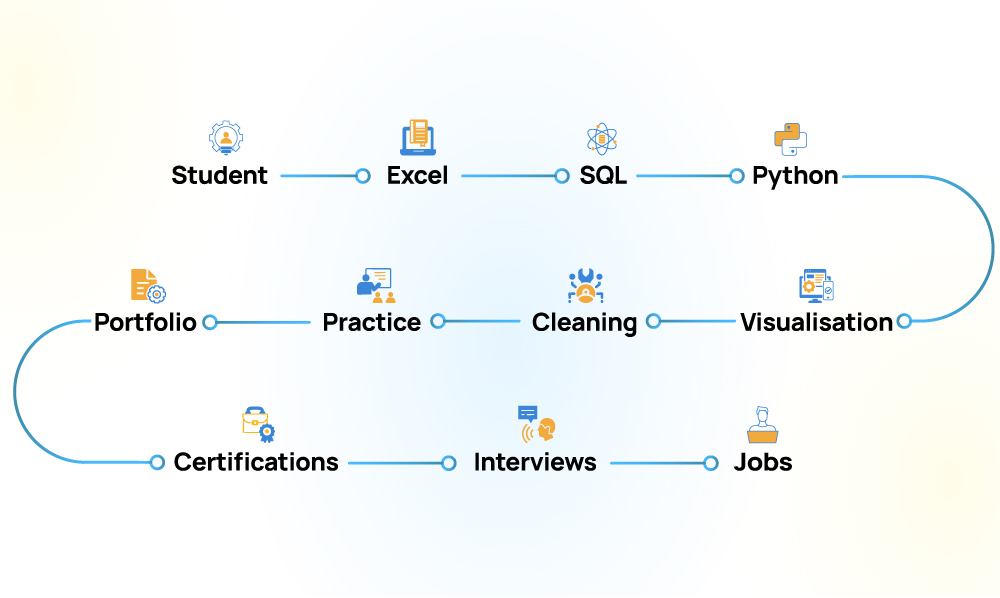
Understand the basics of data and statistics
Before learning any tools, it is important to understand what data represents and how it behaves throughout the data analysis process.
This stage builds the foundation for all future data analyst skills and core statistics. Without it, analysis often becomes mechanical and error-prone, especially when working with large datasets.
At this level, students should focus on:
Understanding different types of data
- Structured and unstructured data
- Numerical and categorical data
Learning basic statistical concepts
- Mean, median, and mode
- Range and standard deviation
- Percentages and ratios
Interpreting data correctly
- Identifying trends and patterns
- Understanding outliers
- Knowing the difference between correlation and causation
These concepts help answer simple but important questions like whether a change in numbers is meaningful or just noise. Strong fundamentals support exploratory data analysis and make advanced tools easier to learn later.
🤔 Why does this matter?
Many beginners rush into tools. Strong fundamentals in data and statistics help you avoid incorrect conclusions later, even when using advanced tools.
Master Excel (foundation tool)
Excel is one of the most important tools in the data analyst roadmap, especially at the entry level.
Despite the rise of advanced tools, Excel remains widely used across companies for reporting, data analysis, managing data, and decision-making. Many fresher data analyst roles expect strong Excel skills as a basic requirement.
Key Excel skills to focus on include:
Cleaning and organising data
- Removing duplicates
- Handling missing values
- Formatting data consistently
Using essential formulas
- SUM, AVERAGE, COUNT
- IF conditions
- VLOOKUP, XLOOKUP
- INDEX and MATCH
Analysing data using pivot tables
- Sorting and filtering
- Pivot tables
- Conditional formatting
Excel helps students understand how raw data turns into summaries and actionable insights. It also builds structured thinking, which is a core data analyst skill. For many freshers, strong Excel skills alone can open doors to internships and junior data analyst roles.
Learn SQL (core requirement)
SQL is a non-negotiable skill for anyone serious about becoming a data analyst.
Most business data is stored in databases, not spreadsheets. SQL allows analysts to retrieve, filter, and analyse this data efficiently by writing SQL queries, including more complex queries as experience grows. Because of this, SQL is often listed as a mandatory requirement in data analyst job qualifications.
Freshers should aim to be comfortable with:
- Writing basic queries using SELECT, FROM, and WHERE
- Filtering data using conditions like AND, OR, and IN
- Sorting and limiting results
- Aggregating data using COUNT, SUM, and AVG
- Grouping data using GROUP BY
- Combining tables using basic JOINs
As analysts grow, they may encounter window functions and advanced querying patterns when analysing large datasets or supporting fraud detection use cases. SQL strengthens independence and supports collaboration with data engineers. This skill is a major part of data analyst requirements across industries and significantly improves employability for freshers.
💡A quick tip
You do not need to master every tool listed in job descriptions. For fresher roles, strong Excel and SQL skills combined with clear thinking are often more valuable than surface-level knowledge of many tools.
Learn a programming language (Python or R)
Learning a programming language is an important step in the data analyst roadmap, but it does not mean becoming a software engineer.
For most students and freshers, Python is the preferred choice. It is easier to learn, widely used across industries, and supported by a strong ecosystem of data analyst tools and programming languages. R is also used in analytics, especially in academic and research-heavy roles, but Python aligns better with most entry-level data analyst jobs.
At this stage, focus on using programming to support data analysis, data handling, and data manipulation rather than on writing complex code.
Key concepts to learn include:
Programming basics
- Variables and data types
- Conditional statements
- Loops and functions
Data analysis libraries
- Pandas for working with datasets
- NumPy for numerical operations
Basic data visualisation
- Creating charts and plots using code
Programming helps automate repetitive tasks, analyse large datasets, and perform deeper exploratory analysis. Over time, it can support statistical modeling, regression analysis, predictive analytics, and even machine learning algorithms.
Data visualisation tools
Data analysis is only useful when insights are communicated clearly. This is where data visualisation and data storytelling play a key role.
Most organisations expect entry-level analysts to be familiar with at least one business intelligence or dashboarding tool. These BI tools help convert numbers into visuals that decision-makers can quickly understand.
Commonly used data analyst tools include:
- Power BI
- Tableau
- Google Looker Studio
Instead of focussing on every feature, freshers should concentrate on:
- Choosing the right chart for the data
- Building clean and readable dashboards
- Highlighting key trends and comparisons
- Avoiding unnecessary design elements
Strong visualisation skills allow analysts to create interactive dashboards and generate reports that support informed decisions. Clear dashboards also demonstrate your ability to communicate insights and influence business decisions.
Data cleaning, wrangling, and data quality
Real-world data is rarely clean, and handling messy data is a core part of a data analyst’s job.
Data cleaning and wrangling involve preparing raw data so that it is accurate, consistent, and ready for analysis. This includes dealing with missing data, missing values, inconsistent formats, and outliers. Many beginners underestimate this step, even though it takes up a significant portion of an analyst’s time.
Common data quality issues include:
- Missing or incomplete values
- Duplicate records
- Inconsistent formats
- Incorrect or outlier values
Important skills to develop at this stage include:
- Identifying data quality issues early
- Deciding how to treat missing or incorrect data
- Documenting cleaning decisions clearly
- Validating results after cleaning
Excel, SQL, and Python are all used for this work. Strong data quality practices are essential to meeting data analyst eligibility expectations and are often tested indirectly during interviews.
Now that we understand the roadmap and essential data analyst skills, let us explore what a data analyst does.
What does a data analyst do?
We have put together a list of the basic day-to-day roles and responsibilities of a data analyst.
Understand business questions and goals
A data analyst’s work starts with understanding the problem that needs answering. This could be a drop in registrations, a change in user behaviour, or performance differences across regions. Analysts clarify what the business wants to know before touching the data, which helps avoid unnecessary or misleading analysis.
Collect and prepare data for analysis
Once the question is clear, analysts move into data collection and collecting data from multiple sources such as databases, spreadsheets, internal tools, or third-party platforms. Most raw data is not analysis-ready. A large part of the role involves data handling, fixing missing values, correcting inconsistencies, and checking overall data quality before proceeding.
Explore data to find patterns and trends
After preparation, analysts perform exploratory data analysis. This stage focuses on understanding how the data behaves rather than predicting outcomes. Using descriptive statistics, comparisons, and exploratory analysis, analysts identify trends, spot anomalies, and uncover key differences across time periods or segments.
Analyse large datasets and apply techniques
In many roles, analysts work with large datasets and apply different data analysis techniques depending on the problem. This may include using SQL queries, data manipulation, or business intelligence tools. In specific domains such as healthcare analytics or fraud detection, analysis can directly impact operational outcomes.
Turn analysis into insights and visuals
The value of analysis lies in how well insights are communicated. Analysts generate reports, build interactive dashboards, and use data visualisation to support data storytelling. Tools like Power BI and other BI tools help analysts create interactive dashboards that enable faster and more informed decisions.
Support advanced analysis and collaboration
With experience, analysts may support statistical modeling, regression analysis, or predictive analytics initiatives. Some collaborate closely with data scientists and data engineers on projects involving machine learning or machine learning algorithms. However, most junior data analyst roles focus on accuracy, clarity, and relevance rather than advanced modelling.
Communicate insights to drive decisions
A key part of the data analyst role is communicating insights to non-technical stakeholders. Analysts translate technical terms into simple language, helping teams make strategic decisions and better business decisions. Clear communication helps ensure that insights actually influence action.
Now that you are familiar with the role of a data analyst, let us explore some common mistakes people, especially freshers, make in their data analyst career journey.
Common mistakes freshers make when learning data analytics
Trying to learn too many tools at once
Many students attempt to learn Excel, SQL, Python, and visualisation tools simultaneously. While this feels productive, it usually leads to shallow understanding. Strong fundamentals in a few core tools matter far more than surface-level exposure to many.
Prioritising certificates over practice
Courses provide structure, but real learning comes from working with datasets. Recruiters care more about how you analyse data and explain insights than how many certificates you have completed.
Skipping data cleaning
Beginners often rush to dashboards and charts without preparing the data properly. In real-world roles, a large part of the job involves cleaning and validating data. Ignoring this step leads to incorrect or misleading insights.
Copying projects without understanding them
Reference projects are helpful, but copying them without understanding the logic does not build problem-solving ability. Interviewers can easily tell when a candidate cannot explain their own work.
Waiting too long to apply
Some freshers delay applications until they feel fully ready. Entry-level roles are designed for learning, not perfection. Applying earlier helps you understand expectations and improve faster.
So what’s the right way to approach a data analyst job? We have laid out the steps below to help youtube started.
Practise with real datasets
Learning tools is important, but practice is what builds real confidence.
Working with real datasets helps students understand data collection, data handling, and exploratory data analysis in realistic scenarios. Public datasets are useful for healthcare analytics, analysing patient outcomes, and experimenting with analysing large datasets.
A simple way to practise is to start with one clear question, clean the dataset enough to answer it, analyse patterns, and summarise insights in plain language.
Build a data analyst portfolio and create a job-ready resume
For freshers, a portfolio often matters more than degrees or certifications.
A data analyst portfolio shows recruiters that you can apply what you have learned and generate actionable insights. Even without formal work experience, it helps establish data analyst eligibility.
Each portfolio project should clearly show:
- The problem you are solving
- The dataset used
- How you cleaned and analysed the data
- The insights you derived
Three to five strong projects are enough.
Your resume should complement the portfolio. Highlight tools clearly, mention projects in a dedicated section, and focus on outcomes rather than tasks. Most data analyst job qualifications prioritise practical ability, and a clean portfolio plus resume helps you stand out.
📊 Did you know?
Recruiters spend only a few seconds scanning fresher resumes. A portfolio with clear problem statements and simple insights often stands out more than complex analysis that is hard to explain.
Recommended certifications and courses
Certifications and courses are useful for structure, especially when you are starting out. They work best when paired with hands-on practice.
When choosing courses, look for ones that:
- Cover Excel, SQL, and Python
- Include practical projects
- Focus on problem-solving, not just theory
Certifications add credibility, particularly for students without internships, but their real value comes from how you apply the learning.
Prepare for interviews
Data analyst interviews test how you think as much as what you know.
Freshers are usually assessed on fundamentals, clarity of thought, and problem-solving approach. Expect questions around statistical analysis, SQL logic, exploratory analysis, and business scenarios.
Preparation should focus on revising basics and explaining reasoning clearly. A helpful tip would be to look up common data analyst interview questions and answers to help you get started.
🎯 Worth knowing before interviews
Interviewers are not expecting perfect answers from freshers. They are listening for how you think, how you explain trade-offs, and whether you can reason through a problem calmly.
Apply for internships and entry-level jobs
Internships and entry-level roles are the best way to gain real-world analytics experience and help build a strong data analyst resume for freshers.
Many companies hiring freshers value learning ability and mindset over experience. Applications can be made through company career pages, internship platforms, analytics firms, startups, and mid-sized companies.
Tailor your resume, highlight relevant projects, and apply consistently.
Career paths after becoming a data analyst
A data analyst role opens up several growth paths.
With experience, you can move into senior analyst roles, business intelligence positions, data science, or work closely with data scientists on machine learning initiatives.
The skills you build are transferable across industries, making data analytics a flexible and future-ready career choice.
How long does it take to become a data analyst?
One of the most common questions students ask is how long it actually takes to become a data analyst.
For most students and freshers, a realistic timeline ranges between four to six months of focused effort. Progress depends on consistency, practice, and continuous learning rather than speed.
Take the first step towards your data analyst career with MyCareernet
Becoming a data analyst is not about learning every tool at once or ticking off certifications quickly. It is about building a solid foundation, practising with real data, and developing essential skills over time.
As you start applying what you have learned, the next step is finding roles that match your skill level and learning goals.
If you are ready to put your skills into action, MyCareernet helps you explore entry-level data analyst roles, internships, and fresher-friendly opportunities across industries. Apply for data analyst jobs on MyCareernet and take a real step towards building your analytics career.
Data analyst roadmap: Frequently asked questions
1. What are the must-have sections on a data analyst resume?
Contact details, a short summary or objective, technical skills, projects or experience, education, and certifications (optional).
For freshers, projects are the most important section.
2. How long should a data analyst resume be?
One page is ideal for students and freshers.
Only extend to two pages if you have strong, relevant experience.
3. What are the most important skills to include on a data analyst resume?
Excel, SQL, basic statistics, one programming language (Python or R), and a data visualisation tool.
List only skills you can confidently explain in an interview.
4. Should I write a resume objective or a professional summary?
Freshers should use a short resume objective.
Candidates with experience or internships can use a professional summary.
5. How can I make my data analyst resume ATS-friendly?
Use a simple layout, standard headings, and keywords from the job description.
Avoid graphics, icons, tables, and complex formatting.
6. What kind of data analyst projects should I include?
Projects that show end-to-end work, from cleaning data to insights.
Focus on clarity, problem-solving, and real datasets rather than complexity.
7. How do I choose the right resume format for a data analyst role?
A hybrid format works best for freshers.
Chronological suits experienced candidates, while functional formats are usually avoided.
8. What do recruiters look for in a data analyst resume?
Clear thinking, strong fundamentals, relevant tools, and well-explained projects.
Practical ability often matters more than certificates or advanced tools.

MyCareernet
Author
MyCareernet brings expert insights and tips to help job seekers crack interviews and grow their careers.