
How AI will affect jobs in 2026 and beyond — and how you can stay ahead

Will AI replace human jobs? Yes, AI is already changing the way we work — taking over repetitive tasks, improving efficiency, and creating exciting new roles. But this goes beyond just about what is being automated; it centres on opportunities for you.
In this article, we will help you understand which jobs might be affected, which skills and sectors are growing, and how you can prepare yourself to stay ahead. You will find practical tips to upskill, pivot when needed, and use AI as a tool to amplify your strengths.
With the right approach, you can not only protect your career but also embrace the opportunities an AI-driven workplace offers — staying confident, capable, and ready for what comes next.
Table of Contents
1. The AI transformation at work2. Will AI replace your job?
3. Jobs most vulnerable to automation
4. Roles thriving despite AI
5. Emerging careers in the AI era
6. AI’s impact on hiring and recruitment
7. Top skills to succeed alongside AI (tech and non-tech)
8. Future-proof your career: actionable steps
The AI transformation at work
Artificial intelligence taking jobs is happening faster than ever, automating repetitive tasks and giving human workers the space to focus on more meaningful, creative, and complex challenges. While this transformation echoes past technological leaps, the pace and scale of AI adoption today are truly unprecedented.
Experts predict that AI is expected to automate or transform 50% to 60% of jobs, with full automation possible by 2050, depending on technological advancements. And generative AI is advancing at breakneck speed, reshaping workplace trends faster than any past technology shift.
Industries like logistics, manufacturing, and cybersecurity are leading the way, opening up exciting AI-driven roles such as data analysts, AI programmers, and machine learning specialists. At the same time, some traditional roles that rely on manual or repetitive tasks may fade, making it essential for workers to adapt and grow their skillset.
💡Pro Tip: Start building AI literacy today. Explore beginner-friendly courses in data analysis, machine learning, or AI tools relevant to your field. Even dedicating just a few hours a week can help you stay ahead, make your work more efficient, and open doors to emerging AI-driven roles
Will AI replace your job?
In their 2025 report, the World Economic Forum (WEF) predicts that AI and automation will displace 92 million roles by 2030, with routine and low-skill jobs being the most vulnerable.
While AI is affecting jobs, it is also expected to create a wealth of new opportunities. Staying curious, continuously upskilling, and developing your soft skills will be key to acing future AI jobs. The same WEF report says that AI and automation will also create 170 million new jobs by 2030.
Moreover, AI’s impact extends beyond just job replacement; it also changes the nature of work itself. Many roles will evolve to incorporate AI tools and systems, requiring workers to collaborate with AI technologies rather than compete against them.
This shift emphasises the importance of critical thinking, problem-solving, and emotional intelligence — skills that artificial intelligence can replace human intelligence only to a limited extent.
Studies often ask ‘how many jobs will AI replace?’ Current estimates suggest significant job displacement, with most jobs seeing some form of AI integration rather than full replacement.
Industries such as healthcare and education, which rely heavily on human judgement and trust, are less likely to see full automation but will benefit from AI augmenting human capabilities.
With AI reshaping the nature of work across industries, some roles are naturally more exposed to automation than others. Understanding which jobs are most at risk can help you make informed career decisions, focus on in-demand skills, and identify opportunities where human expertise remains irreplaceable.
Jobs most vulnerable to automation
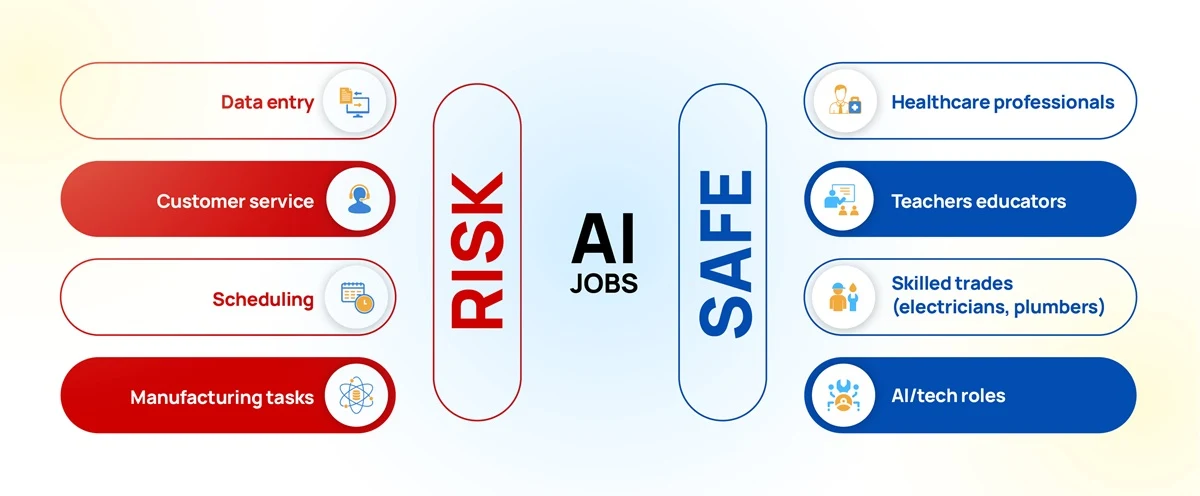
As AI technology advances, some jobs are more exposed to automation than others. Roles involving routine and repetitive tasks, such as:
- Data entry
- Customer service representative
- Scheduling
are particularly vulnerable. Both blue-collar and white-collar roles with straightforward tasks are likely to be transformed by AI’s speed and efficiency.
The impact is not limited to office-based or routine roles; many hands-on and technical jobs are affected by AI as well. In certain industries, repetitive human labor may no longer be the same job it once was, as AI takes over routine tasks across the labor market.
Manufacturing and skilled trades
The manufacturing sector is among the most AI-exposed industries. Automated systems and robotics powered by AI algorithms are increasingly taking over manual tasks such as assembly line work and quality control. While this may reduce the number of traditional factory jobs, it simultaneously creates demand for workers skilled in maintaining and programming AI systems.
Logistics and autonomous vehicles
AI adoption in logistics is revolutionising supply chain management. Autonomous vehicles and automated warehouses improve efficiency but also threaten jobs traditionally held by human drivers and warehouse workers. However, new roles in AI system oversight and logistics data analysis are emerging to support these technologies.
Legal services and administrative assistants
AI tools are increasingly capable of performing legal research, contract drafting, and data analysis, impacting roles like paralegals and administrative assistants. Large language models (LLMs) can process vast amounts of information faster than human workers, providing valuable insights but also reducing the need for routine manual tasks in legal services.
Customer service and retail
Customer service representatives are among the most AI-exposed jobs due to the rise of chatbots and automated systems that handle routine inquiries. Similarly, grocery stores and retail outlets are adopting self-checkout stations and AI-powered inventory management, reshaping the roles of traditional retail workers.
Graphic design and creative fields
Graphic design is another area experiencing AI exposure. AI-generated art tools are becoming increasingly sophisticated, allowing businesses to create visuals quickly and at a lower cost. While this threatens some graphic design roles, it also pushes designers to focus on creativity and complex projects that AI cannot replicate, promoting job growth and skill diversification.
But even as AI transforms certain roles, many jobs are evolving or expanding, offering opportunities where human skills remain indispensable.
Roles thriving despite AI
Jobs requiring human judgment, creativity, and empathy remain secure, while other industries see roles evolve with the skills needed to complement AI. Roles in healthcare, education, skilled trades, and creative fields continue to grow due to the unique human presence they require.
For example, healthcare professionals benefit from AI tools analysing patient data but still provide the human touch necessary for effective care. Teachers, therapists, and social workers rely on emotional intelligence and human trust, making their roles difficult to replace.
Skilled trades such as electricians and plumbers involve manual dexterity and problem solving that AI and robotics cannot easily replicate. Creative professions like artists and writers also remain resilient, as AI-generated content lacks the nuanced creativity and originality of humans.
However, not only are certain roles safe or growing, but AI is also opening doors to entirely new careers. Understanding these emerging opportunities can help you pivot, upskill, and position yourself for the jobs of tomorrow.
Emerging careers in the AI era
While AI may replace certain jobs, it also creates new job opportunities, especially in AI development, data science, and related fields. Roles such as AI programmers, machine learning specialists, prompt engineers, and AI ethics specialists are in growing demand.
Other emerging jobs include health tech implementation specialists and AI literacy trainers who help organisations and individuals adopt AI technologies effectively. New roles are also booming in areas like computer systems design, where workers with new skills can solve problems AI cannot handle alone.
AI will create millions of new jobs globally, particularly in sectors like healthcare, technology, and education. These new roles require a combination of technical skills and soft skills like critical thinking and adaptability, ensuring a dynamic and evolving job market filled with high-demand jobs in future.
At the same time, as the job landscape evolves, AI is also transforming how organisations find and hire talent, changing recruitment processes and the skills they prioritise.
AI’s impact on hiring and recruitment
AI is transforming hiring by automating candidate screening, resume analysis, and initial interviews. AI-powered tools can process large volumes of applicant data quickly, identifying the best matches and reducing human bias. AI-powered recruitment tools also analyse useful data on applicants. This shift may influence unemployment rates as hiring becomes more skills-driven than experience-driven.
However, human presence remains critical in recruitment for assessing cultural fit, interpersonal skills, and complex decision-making.
Employers increasingly adopt AI systems to improve efficiency, but balancing AI usage with human judgement is essential for fair and effective hiring practices. Preparing for this new landscape requires updated interview preparation tips to succeed.
Employers are increasingly looking for candidates who can complement technology rather than compete with it. Let us explore the technical and non-technical skills that are in high demand in this new AI-driven era.
Top skills to succeed alongside AI (tech and non-tech)
To remain competitive, workers need a blend of technical and soft skills:
- Technical skills: Machine learning, data analytics, AI system management, and programming
- Soft skills: Emotional intelligence, critical thinking, problem-solving, adaptability, and effective communication
Lifelong learning and staying updated on market trends and new technology are vital for career growth and skill development. Focussing on high-paying skills to learn, such as AI development and data science, will help you stay ahead in the evolving labour market.
To stay competitive, you must continually learn new skills — both technical and human-focused — to thrive alongside AI.
Open the gateway to AI jobs and learning with MyCareernet
The AI-driven workplace is full of opportunities — if you know where to look. MyCareernet connects you with the tools, networks, and experiences to stay ahead and thrive in this evolving landscape.
- Explore high-income jobs: Discover roles in AI, data science, machine learning, and other in-demand fields that match your skills and ambitions.
- Participate in events: Attend webinars, workshops, and expert-led sessions to learn the latest AI trends, enhance your knowledge, and build connections.
- Join hackathons: Apply your skills in real-world challenges, gain hands-on experience, and showcase your capabilities to potential employers.
Start applying with MyCareernet and position yourself for success in an AI-powered world.
Frequently asked questions on AI job replacements
AI will automate repetitive and routine tasks, which may reduce demand for some roles. However, it also creates new jobs and opportunities, especially in tech, creative, and human-centred professions. The key is to upskill and adapt.
AI adoption varies by industry. Sectors like logistics, manufacturing, customer service, and legal services are seeing rapid changes, while healthcare, education, and creative fields are evolving more gradually.
Both. AI streamlines recruitment through resume analysis and candidate screening, making some processes faster. But it also raises the bar, requiring candidates to have skills that complement AI rather than compete with it.
Roles that demand AI literacy, advanced technical skills, and complex human judgement are likely to see higher salaries. Routine or easily automated jobs may face slower wage growth. Upskilling is key to staying competitive.
AI tools can enhance remote collaboration and productivity, potentially increasing remote work options. At the same time, some roles may require AI supervision or hands-on tasks that are location-dependent.
Not always, but pivoting to high-demand, AI-resistant, or AI-complementary roles can be worthwhile. Focus on areas where your human skills — creativity, problem-solving, empathy — are hard to automate.

MyCareernet
Author
MyCareernet brings expert insights and tips to help job seekers crack interviews and grow their careers.