
What is generative AI? How it works, examples, benefits, and careers
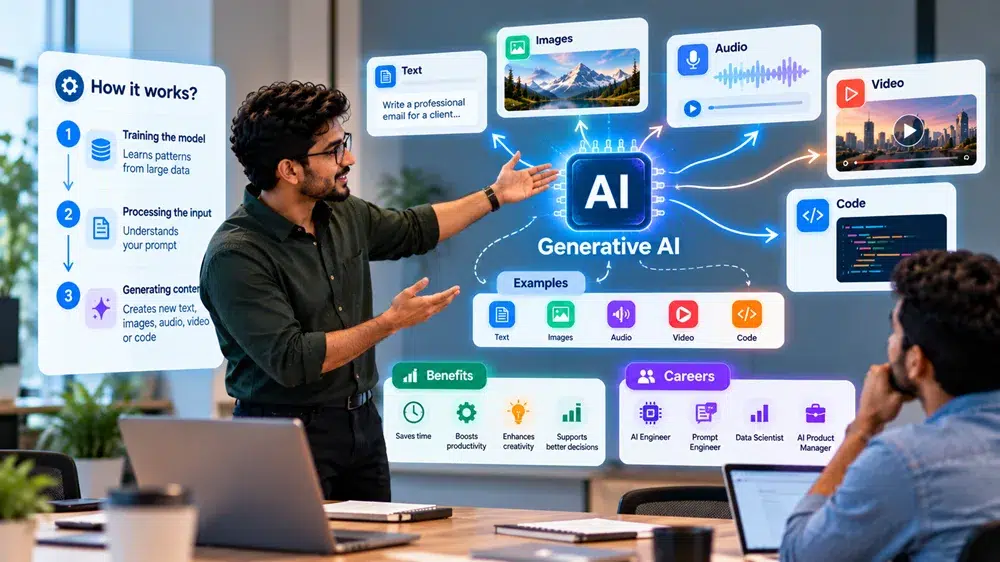
Artificial Intelligence (AI) tools can now generate text, images, and code, but how do they create new content from a simple instruction? If you are exploring AI, you may be asking, what is generative AI, and how can you use it?
This guide explains how generative AI works, explores its types, examples, benefits, and applications, and introduces career opportunities in the field.
📌 Key takeaways
- Generative AI foundation: Generative AI creates new content by learning patterns from training data.
- Diverse model architectures: Different model architectures support different tasks, from generating text to creating images.
- Importance of human review: Human review helps identify errors, bias, and privacy risks in AI-generated outputs.
- Practical learning: Practical projects help you apply generative AI concepts and demonstrate your skills to potential employers.
Table of contents
1. What is generative AI?2. How does generative AI work?
3. What is the difference between AI and generative AI?
4. What are foundation models and large language models?
5. What can generative AI create?
6. What are the different types of generative AI models?
7. What are the common applications of generative AI?
8. What are the benefits of generative AI?
9. What skills do you need to learn generative AI?
10. How to learn generative AI: A step-by-step guide
11. What is the future of generative AI?
12. Explore generative AI job opportunities
13. Frequently asked questions
What is generative AI?
Generative artificial intelligence (generative AI) is a type of AI that creates new content, such as text, images, audio, video, and code, by learning patterns from existing data. If you are wondering what Gen AI is, it is technology that generates outputs in response to prompts or other inputs rather than only classifying information or making predictions.
The key feature of generative AI is its ability to generate new outputs based on patterns learned during training. Results depend on the model, training data, and the task it is designed to perform. These outputs can be useful starting points, but they are not necessarily accurate, original in every legal sense, or ready to use without review.
How does generative AI work?
Generative AI systems use models, often built with neural networks and deep learning, to learn patterns and relationships in training data. Depending on the model and training approach, this data may be labeled or unlabeled.
The process generally involves three stages:
- Training the model: The model learns patterns from training data. Different approaches use different learning objectives, such as predicting missing information or learning relationships between inputs and outputs.
- Processing the input: When you provide a prompt or other input, the model processes it using the patterns and representations learned during training.
- Generating content: The model produces an output, such as a written response, image, audio clip, or code snippet.
For example, when you ask a large language model to draft a professional email, it uses your instructions and the context provided to generate text suited to the requested purpose and tone.
💡 Pro tip
Include the task, relevant context, intended audience, desired format, and any constraints in your prompt. Review the result against your requirements rather than assuming that a detailed prompt guarantees an accurate answer.
What is the difference between AI and generative AI?
Artificial intelligence (AI) is a broad field of technology that enables machines to perform tasks such as recognizing patterns, analyzing information, making predictions, and supporting decisions. Generative AI is a subset of AI focused on producing new content.
| Aspect | Traditional AI | Generative AI |
|---|---|---|
| Primary purpose | Classify information, predict outcomes, or recommend actions | Generate new content based on learned patterns |
| Output | Predictions, classifications, or recommendations | Text, images, audio, video, or code |
| Example | An email filter that identifies spam | A tool that creates an image from a text prompt |
| Common applications | Fraud detection, forecasting, and recommendation systems | Content creation, image generation, and code assistance |
Note: This is a simplified comparison. AI systems can combine predictive and generative capabilities, and generative AI tools can also analyze information.
What are foundation models and large language models?
Foundation models are AI models trained on broad datasets that can be adapted to support different tasks. Developers may adapt them through techniques such as fine-tuning or instruction tuning. Some training processes also use human feedback to improve how a model responds to instructions.
Large language models (LLMs) are models designed to process and generate human language. Many are foundation models and power conversational AI tools that answer questions, summarize documents, assist with coding, and translate text.
Image-generation models are designed for visual outputs and may use different architectures, including diffusion models. Unlike an LLM that generates language, an image-generation model creates visual content from a prompt or other input.
Another technique used with language models is retrieval-augmented generation (RAG). RAG retrieves relevant information from an external source, such as a document collection, and supplies it as context when the model generates a response. This can help ground answers in relevant information, but it does not guarantee accuracy. The retrieved material and the generated answer still need to be checked.
💡 Pro tip
Choose a model based on the task you need to complete. For example, use a language model to summarize a report, an image-generation model to create a visual concept, or a RAG-based system to answer questions using a specific set of documents.
What can generative AI create?
Generative AI can produce different types of content depending on the model and input:
- Text: Emails, summaries, blog posts, and reports.
- Images: Illustrations, concept art, and design ideas.
- Audio: Voiceovers, music, and sound effects.
- Video: Short clips, animations, and video edits.
- Code: Scripts, functions, and application prototypes.
These outputs can support creative work, communication, and software development. Their quality depends on the model's capabilities, the input provided, and how well the output is evaluated and refined.
What are the different types of generative AI models?
Generative AI models use different methods to learn patterns and generate content. Some categories describe how a model generates outputs, while others describe its architecture, so they are not always mutually exclusive.
Generative adversarial networks (GANs)
GANs use two neural networks that compete during training. One generates synthetic content, while the other learns to distinguish generated examples from real data. This process can help the generator produce realistic outputs.
Variational autoencoders (VAEs)
VAEs learn compressed representations of data and use them to generate new samples. They can support image generation, data augmentation, and synthetic data creation.
Diffusion models
Diffusion models learn to generate content by reversing a process that adds noise to data. Many image-generation systems use this approach, gradually turning a noisy representation into an image guided by a prompt.
Autoregressive models
Autoregressive models generate a sequence one element at a time, using previously generated elements to predict what comes next. Many language models use this approach to generate text and code.
Transformer-based models
Transformers use attention mechanisms to identify relationships between elements in input data. They underpin many large language models and are also used in other AI applications. Transformer-based models can overlap with autoregressive models because one describes the architecture and the other describes a generation approach.
What are the common applications of generative AI?
Generative AI tools support content creation, problem-solving, and repetitive tasks across industries. Common applications include:
- Content creation: Draft blogs, marketing copy, product descriptions, and social media posts.
- Image and video generation: Create visual concepts, illustrations, and video assets from prompts.
- Software development: Assist with code generation, debugging, and documentation.
- Customer support: Help virtual assistants draft responses, summarize requests, and retrieve relevant information.
- Education: Generate practice questions, explain difficult concepts, and support personalized learning materials.
- Healthcare research: Support activities such as drug discovery research and synthetic data generation, subject to appropriate validation and safeguards.
- Business processes: Summarize reports, extract information from documents, and assist with repetitive workflows.
These applications show how generative AI is being integrated into everyday workflows to improve efficiency and support creative and analytical tasks. Understanding what Artificial Intelligence is can help you see how generative AI fits into the broader field of AI and how these technologies are used to solve different problems.
What are the benefits of generative AI?
Generative AI can help individuals and organizations work with information and create content more efficiently. Its practical benefits include:
| Benefit | How it helps |
|---|---|
| Efficiency | Speeds up first drafts, summaries, and repetitive tasks. |
| Creativity | Generates ideas and alternative approaches for further development. |
| Personalization | Helps adapt content to different audiences, contexts, and needs. |
| Experimentation | Generates synthetic data or multiple concepts to support testing, where appropriate. |
These benefits depend on the task and the quality of the output. Review generated content for factual errors, bias, privacy concerns, and suitability before using it in a final deliverable.
What skills do you need to learn generative AI?
The skills you need depend on whether you want to use AI tools in your current work, build AI-powered applications, or develop models. Useful starting points include:
- AI and machine learning fundamentals: Learn how models are trained and how generative systems produce outputs.
- Prompt engineering: Write clear instructions, provide useful context, and refine prompts based on results.
- Data literacy and evaluation: Check claims, interpret information, identify patterns, and assess output quality.
- Programming: Learn Python and basic programming if you plan to build or customize AI applications.
- Critical thinking: Identify unsupported claims, errors, and potential bias.
- Responsible AI practices: Understand data privacy, security, intellectual property considerations, and ethical use.
💡 Pro tip
Start with prompt engineering and AI fundamentals, then build your technical skills based on the generative AI applications you want to work with.
How to learn generative AI: A step-by-step guide
You can learn generative AI by starting with the basics and gradually applying your knowledge through practical projects.
- Learn AI fundamentals: Understand artificial intelligence, machine learning, deep learning, and how generative AI models work.
- Practice prompt engineering: Use generative AI tools to write prompts, refine outputs, and solve simple tasks.
- Compare tools and models: Test text, image, and code generation to understand their capabilities and limitations.
- Build a small project: Create a chatbot, develop a content-generation workflow, or generate visuals for a defined use case.
- Evaluate the results: Check accuracy, usefulness, consistency, privacy, and potential bias against clear requirements.
- Document your work: Explain the problem, your approach, the tools used, the results, and the improvements you made.
💡 Pro tip
Choose a project that solves a real problem. A well-documented project shows not only that you can use AI tools, but also that you can evaluate their output and explain the value of your solution.
What is the future of generative AI?
Generative AI is being applied to more than content creation, including software development, research, and business workflows. As these applications evolve, opportunities may grow for professionals who can apply AI tools to specific problems, evaluate results, and build reliable solutions.
The skills required will vary by role. Some positions focus on applying existing tools, while others involve software development, data engineering, model evaluation, or machine learning. Building practical experience around a clear use case can help you identify the direction that suits your interests and existing skills.
Explore generative AI job opportunities
Take the next step in your generative AI career with MyCareernet
Learning generative AI is a starting point for exploring opportunities in AI engineering, prompt engineering, and related fields. As you build your skills, work on practical projects and identify roles that align with your interests and experience.
Explore the job links below to discover relevant opportunities and understand the skills employers are looking for. Sign up on MyCareernet to explore more job opportunities and take the next step towards your career goals.
Explore Generative AI Job Opportunities on MyCareernet
Ready to take the next step towards your career goals?
Sign up on MyCareernet →Frequently asked questions
1. Can a fresher start a career in generative AI?
Yes. Freshers can start by learning AI fundamentals, practising with generative AI tools, and building small projects to demonstrate their skills.
2. Do generative AI jobs require coding skills?
Not all roles require coding. Prompt engineering and AI content roles may need limited programming, while AI engineering and model development typically require stronger coding skills.
3. What qualifications are needed for a generative AI career?
Requirements vary by role. AI engineering positions often favour computer science, data science, or related technical backgrounds, while other roles may prioritise practical AI skills and project experience.
4. How long does it take to learn generative AI for a job?
The timeline depends on your starting skills, target role, and learning pace. Focus on building relevant skills and completing practical projects rather than following a fixed timeline.

MyCareernet
Author
MyCareernet brings expert insights and tips to help job seekers crack interviews and grow their careers.