
Common interview questions and answers every fresher should know – 2026

1. Basic interview questions for freshers
These are the most common job interview questions you can expect. They help employers evaluate your self-awareness, confidence, and suitability for the work environment.
At this stage, interviewers look for clarity of thought, curiosity, and a sense of purpose in your responses. The way you describe your experiences and interests reveals how you approach learning, adapt to new situations, and align with the organisation’s goals. For more expert advice, you can read these insights from a leadership coach on how to crack interviews.
Tell me about yourself and your background
This is usually the first question in a job interview, and it sets the tone for the rest of the conversation. Keep your introduction short, structured, and relevant. Use this opportunity to connect your academic background, key achievements, and interests with the role you are applying for.
A thoughtful and well-organised response demonstrates clarity, confidence, and an understanding of how your strengths align with the company’s goals. If you need help structuring your introduction, check out our guide on how to write a resume for freshers which covers how to present your background effectively.
“I am a Computer Science graduate who enjoys working on data-driven projects. During my internship at ABC Technologies, I helped the sales team automate reporting using Excel and Power BI, which improved efficiency by 25 per cent. I am genuinely interested in roles that let me apply my analytical and coding skills while learning from experienced professionals.”
This answer reflects your technical skills, teamwork, and self awareness.
What attracted you to this position?
Recruiters ask this question to understand your genuine interest in the current company and how well you connect your aspirations with the role. Your response should show that you have explored the organisation’s goals, studied the job description, and recognised how the opportunity aligns with your skills and values. It gives hiring managers insight into your motivation, curiosity, and how you approach your career path with intention and purpose.
“This role focuses on data analysis and problem solving, both of which I enjoy. I also admire the company’s mission to use technology for innovative solutions.”
A clear understanding of what draws you to a role helps you communicate purpose, but it is equally important to reflect on what you bring to the table. That is where identifying your strengths and areas of improvement becomes essential.
What are your greatest strengths and weaknesses?
Choose strengths that align closely with the job description and highlight qualities that can help you succeed in the role. Focus on attributes such as communication skills, problem solving skills, teamwork, adaptability, or attention to detail. To identify the best skills to mention, review our list of top skills freshers should include in their resume.
When discussing a weakness, choose one that is genuine yet manageable, and explain the steps you are taking to improve. This question helps hiring managers assess your self awareness, willingness to learn, and ability to transform challenges into opportunities for personal growth and professional development.
“My strength is adaptability. I work well in a team environment and contribute positively to group projects. As for weakness, I used to hesitate in public speaking, but I have improved through presentations and team meetings.”
Recognising your strengths and weaknesses is only the first step; what truly matters is how you act on them and continue to grow.
Are you working on improving any of your weaknesses?
Show active learning through courses, workshops, or mentorship, and explain how these efforts have strengthened your overall performance. You can mention specific steps such as practising public speaking, refining your technical knowledge, or improving your time management skills.
Employers appreciate candidates who take ownership of their development and demonstrate a proactive attitude towards professional growth.
“One area I have been working on is improving my public speaking skills. I realised that presenting ideas clearly in front of a group is essential for effective teamwork and leadership. To address this, I joined a communication workshop at my university and volunteered to present during team meetings. These experiences have helped me gain confidence and express my thoughts more clearly.”
This question gives you an opportunity to highlight your resilience, curiosity, and long-term commitment to continuous learning and professional development.
Where do you see yourself professionally in the next five years?
Connect your career goals to the company’s career path and growth opportunities. Share how you envision contributing to the organisation’s success while developing your own expertise. This question allows you to express ambition with a sense of direction, showing that you have thought about your professional career beyond the present role. To craft a strong statement, look at examples of career objectives for freshers.
A clear and realistic answer reflects commitment, focus, and a genuine interest in building a long-term association with the organisation.
“In the next five years, I see myself growing into a role that allows me to take on more responsibility and lead projects. I hope to deepen my expertise in data analytics, contribute to impactful business solutions, and continue learning through real-world challenges within the organisation.”
Having a clear vision for your professional growth is important, but employers also want to understand how your current skills and mindset make you a strong fit for the role today.
Why do you believe you are the right candidate for this role?
Highlight a mix of important skills such as technical knowledge, adaptability, and collaboration. Support your response with specific examples from academic projects or internships that demonstrate your strengths.
Employers value candidates who can apply what they have learned, communicate effectively, and work well in a team environment. This question allows you to emphasise how your experiences and approach to work directly support the responsibilities of the role and the organisation’s broader objectives.
“I believe my technical knowledge and collaborative mindset make me a strong fit for this role. During my internship, I worked closely with a cross-functional team to streamline reporting processes, which strengthened my problem-solving and communication skills.”
Demonstrating that you are the right fit for the role sets the foundation, but interviewers also want to see how you plan to grow and evolve.
What are your short-term and long-term career goals?
Mention goals that reflect learning and professional growth, such as mastering new skills, gaining hands-on experience, or taking up leadership opportunities in the future. Your answer should show that you are ambitious yet realistic, and that you understand how your goals align with the organisation’s growth.
“In the short term, I want to strengthen my technical and analytical skills by working on real-time projects and learning from experienced mentors. In the long term, I aspire to take on more responsibility, lead a team, and contribute to initiatives that drive innovation and measurable results for the organisation.”
A clear sense of direction matters, but interviewers also want to know whether your aspirations align with the organisation you have chosen. This is where understanding the company and its values becomes essential.
What do you know about our company, and why do you want to join us?
Show that you have researched the company’s culture, company’s mission, and values. This question helps interviewers assess how genuinely interested you are and how your goals align with the organisation’s direction. You can refer to something you discovered during your job search, such as a recent initiative, leadership approach, or innovation that reflects the company’s growth mindset.
“I have read about the company’s efforts in driving innovation and fostering employee development. What drew me most is your collaborative culture and focus on continuous improvement, which aligns with how I see my own career growing.”
When you convey genuine enthusiasm for the company, it naturally opens the conversation to practical aspects of the role, such as how you see yourself fitting in and your expectations for compensation.
What are your salary expectations?
Be open and realistic about the salary range for freshers. This question helps interviewers assess whether your expectations align with the company’s compensation plan. You can mention that you have explored the average range during your job search and are open to discussions based on the role and growth opportunities.
“I am flexible and open to learning about your compensation structure for this position. My main focus is to grow in a role that supports learning and skill-building.”
If applicable, why are you considering a career switch?
Frame it positively and show that your interests or personal projects helped you discover a better fit for your professional career. Highlight what you learned in your previous experience and how those skills can add value in your new direction.
“While working on a project during my internship, I discovered a strong interest in data analytics. That experience encouraged me to pursue opportunities that align more closely with my analytical strengths.”
2. Educational background and academic questions
These questions connect your academic foundation to your current position or dream job. Interviewers use them to evaluate your education and how your resume format highlights these achievements. To ensure your resume is up to standard, check our guide on best resume formats for 2025.
Can you share some of your key academic achievements?
Highlight awards, research, or achievements relevant to your current job. You can also mention academic events, competitions, or group projects where you demonstrated leadership or problem-solving abilities. Providing measurable outcomes or recognition makes your response more credible.
“In my final year, I led a research project on sustainable design and presented the findings at an intercollegiate seminar. This experience strengthened my analytical and presentation skills, which I believe will help me contribute meaningfully in a professional setting.”
Have you worked on any projects or internships? Please tell us about your experience.
Describe your project, objectives, tools, and results. Emphasise how you collaborated with your team, solved challenges, and met deadlines. If you haven't done one yet, read why you should do an internship and how to get started.
“In my final semester, I built a project management dashboard using Python and Excel. It tracked team performance, and we used it to manage multiple group projects efficiently.”
3. Behavioural and situational interview questions
These questions assess how you respond to real-world challenges, teamwork, and responsibility. Interviewers use them to evaluate your self-awareness, emotional intelligence, and approach to problem solving. The goal is to understand how you think, act, and adapt, as these qualities often define long-term success in any professional career.
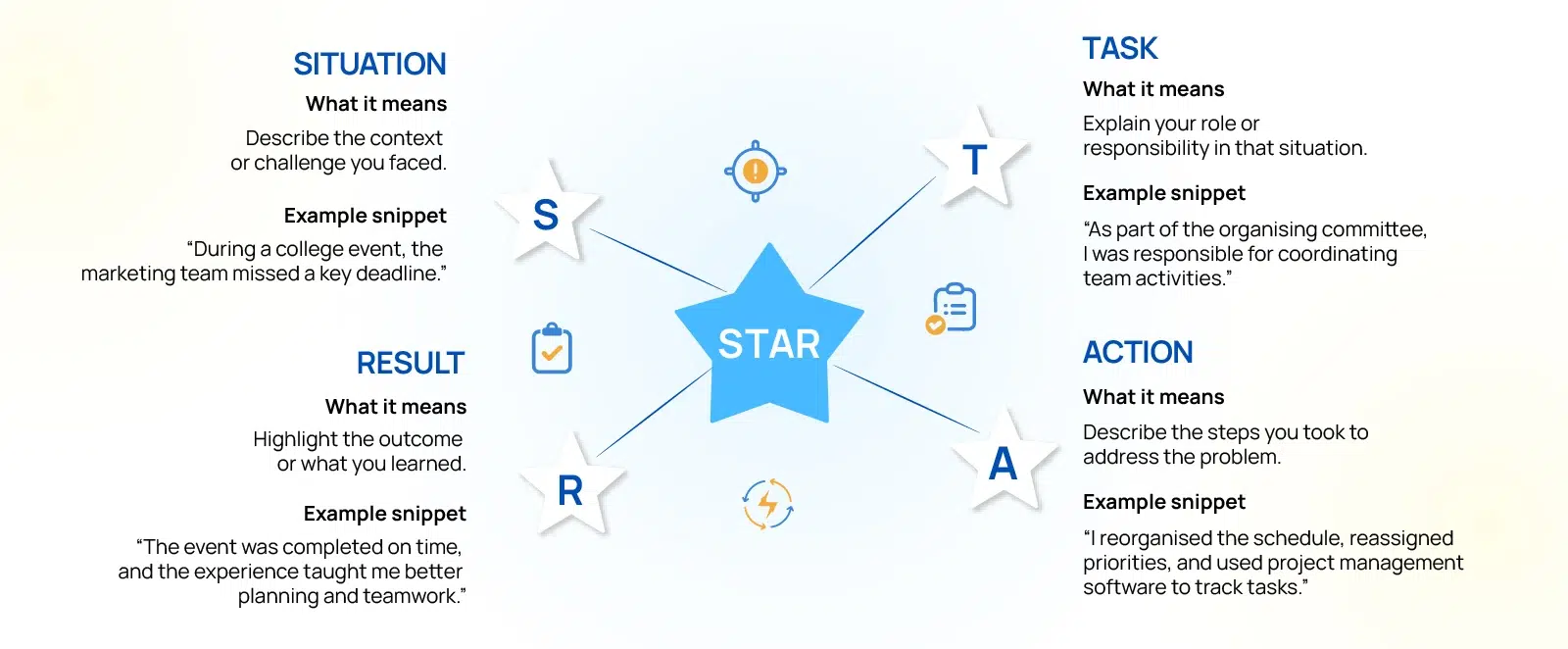
| Step | What it means | Example snippet |
|---|---|---|
| S – Situation | Describe the context or challenge you faced. | “During a college event, the marketing team missed a key deadline.” |
| T – Task | Explain your role or responsibility in that situation. | “As part of the organising committee, I was responsible for coordinating team activities.” |
| A – Action | Describe the steps you took to address the problem. | “I reorganised the schedule, reassigned priorities, and used project management software to track tasks.” |
| R – Result | Highlight the outcome or what you learned. | “The event was completed on time, and the experience taught me better planning and teamwork.” |
Use the STAR method to make your answers clear, structured, and outcome-oriented.
Describe a challenging situation you encountered and how you resolved it
Employers want to know about your problem solving skills and ability to stay calm under pressure. Focus on situations where you showed initiative, worked collaboratively, or found an innovative solution. Choose an example that demonstrates ownership and learning rather than simply describing a difficulty.
“During a college event, the marketing team missed a deadline. I stepped in to coordinate with the design team, managed tasks using project management software, and ensured we completed on time. It taught me to stay calm under pressure and communicate clearly.”
Give an example of a time you demonstrated leadership skills
Share specific instances where you led a team or project. You can talk about a time when you motivated others, took initiative, or helped resolve a conflict. This question helps interviewers assess your ability to guide and support others, which is a valuable trait for future project managers and team leads.
“As part of my final-year project, I volunteered to lead a four-member team. I divided the tasks based on individual strengths, set weekly milestones using Trello, and ensured open communication throughout the process. We completed the project ahead of schedule and received appreciation for our teamwork and organisation.”
How do you respond to feedback or criticism?
Show openness to learning and self-improvement. Employers value candidates who can accept feedback positively and use it to refine their work. Emphasise how you see feedback as an opportunity to improve performance rather than as a setback.
“I see feedback as an opportunity for personal growth. At my internship, a hiring manager suggested improving my presentation flow. I worked on it and saw a positive outcome in my next client meeting.”
How do you prioritise tasks when managing multiple responsibilities?
Mention the methods or tools you use to stay organised, such as creating task lists, setting deadlines, or using digital planners. Discuss how you balance quality and speed to meet expectations effectively.
“I usually begin by identifying urgent and important tasks using a simple priority matrix. I plan my day with short milestones and use reminders to stay on track. This approach helps me manage workload efficiently without compromising quality.”
How do you cope with stressful situations?
Employers want to know how you maintain focus and composure when faced with challenges. Mention techniques such as planning, deep breathing, or consulting a team member for support.
“When faced with tight deadlines, I start by breaking the task into smaller steps and setting realistic timelines. If needed, I seek suggestions from my teammates to find quicker solutions. Staying calm and focusing on progress helps me deliver consistent results.”
4. Technical and role-specific questions
These questions test your technical skills and how effectively you can apply knowledge in real situations. Employers use them to evaluate your readiness for the role, your ability to work with relevant tools, and your commitment to continuous learning.
What technical skills have you learned?
List tools or technologies related to your job description, such as Python, SQL, CRM tools, or digital marketing platforms. You can also mention any software or technical processes you mastered during academic projects or internships.
“I have hands-on experience with Python, Excel, and Tableau from my academic projects. I also worked on data visualisation assignments that helped me understand how to turn raw data into clear insights. I regularly follow data analyst interview questions to stay sharp on core concepts.”
Have you used any tools or software related to this position?
Describe your experience with design tools, analytics platforms, or project management applications. This question helps employers understand your comfort level with tools used in their organisation and how quickly you can adapt to new systems.
“During my internship, I used Power BI to create weekly sales dashboards that helped the team track performance. I also collaborated with the operations team using Trello to manage progress on client deliverables.”
How do you keep your technical knowledge and skills up to date?
Mention online courses, webinars, or professional development programmes. You can also share how you follow industry experts, take part in personal projects, or explore new tools to strengthen your learning. This is especially important as technologies evolve, so knowing how AI will affect jobs is key to staying ahead.
“I make it a point to learn something new every few months through online platforms. Recently, I completed a course on data analytics and attended a webinar on emerging trends in AI, which helped me gain practical insights beyond the classroom.”
5. What questions to ask in an interview
Asking thoughtful questions shows initiative, curiosity, and genuine interest in the company’s work environment. These questions help you assess whether the role, team, and organisation align with your values and long-term career goals.
What does a typical day look like?
This question helps you understand the company’s workflow, your daily responsibilities, and the balance between independent tasks and collaboration. It also gives you insight into how structured or flexible the role might be, helping you visualise what success looks like in that position.
What are the growth opportunities?
Asking about career progression demonstrates long-term thinking and ambition. It shows that you are motivated to develop your skills and take on greater responsibility. This also helps you identify whether the company supports internal mobility, structured learning programmes, or exposure to diverse projects that foster professional growth.
How would you describe the company culture?
Company culture shapes how people work, communicate, and celebrate success. Learning about the organisation’s values, leadership approach, and collaboration style helps you assess whether it aligns with your working style and principles.
What kind of training or mentorship is offered to freshers?
Inquiring about mentorship or training shows enthusiasm for learning and continuous improvement. It also gives you clarity on how the company invests in developing young professionals, whether through structured onboarding, workshops, or regular feedback sessions with mentors and managers.
How does the company support work-life balance?
Understanding how the organisation promotes balance reflects that you value productivity and mental well-being equally. You can get a sense of their flexibility, support systems, and overall approach to employee welfare, which are key to building a sustainable and fulfilling career.
6. Essential tips for freshers to ace interviews
Success in an interview often depends on the small details, how well you prepare, how clearly you communicate, and how confidently you present your ideas. These tips focus on practical actions that help you stand out, build credibility, and leave a professional impression.
- Research the company thoroughly before the interview: Understand the company’s mission, products, and work culture. Knowing the organisation’s recent projects or milestones helps you tailor your responses.
- Practice common interview questions but keep responses natural: Rehearse aloud to strengthen your communication skills and confidence. Focus on understanding the intent behind each question so your answers sound authentic rather than memorised.
- Dress appropriately for a professional setting: Your appearance reflects respect for the opportunity. Choose attire that aligns with the company’s environment and helps you feel confident and comfortable.
- Maintain positive body language throughout the interview: Make eye contact, listen actively, and project confidence. A calm smile and attentive posture can often make a stronger impression than words.
- Be honest, confident, and clear: Hiring managers appreciate authenticity and composure. Speak clearly, own your experiences, and express both your enthusiasm and willingness to learn.
- Send a thank-you email after the interview: Reaffirm your genuine interest and appreciation for the interview process. A short, polite note helps you leave a lasting impression and strengthens professional goodwill.
Every interview, whether for your first job or a career switch, is a chance to showcase your readiness, skills, and personality. From communication skills to problem solving skills and teamwork, employers want candidates who can learn quickly and contribute positively.