
How to Write a Resume for Freshers: Step-by-Step Writing Guide

Picture yourself as a recruiter for a day.
Your inbox is filled with hundreds of applications, each claiming to be passionate, hardworking, and eager to learn. You have only a few seconds to glance at every resume before deciding who moves forward. In that quick scan, what would make you stop and take a closer look?
That is exactly how your fresher resume will be judged. Recruiters spend an average of seven seconds reviewing a resume, and in that short window, clarity, structure, and relevance matter more than anything else. A well-crafted resume helps you stand out not because you have years of experience, but because you communicate potential with confidence and purpose.
This guide will show you how to write a fresher resume that captures attention and tells your story effectively—from choosing the right format to highlighting your achievements, skills, and career goals.
💡Recruiter’s insight: On average, recruiters receive over 200 applications for every entry-level role. Only resumes that are clear, easy to read, and relevant make it past the first round.
Table of Contents
1. What Recruiters Look for in Fresher Resumes2. How to Write a Resume for Freshers
3. Choose the Right Format for Your Fresher Resume
4. Prepare Your Information
5. Resume Writing Guide
6. Resume Headline Writing with Examples for Freshers
7. Contact Information
8. Resume Objective or Summary Statement
9. Education Information
10. Skills to Mention in a Resume
11. Internships and Projects
12. Achievements and Certifications
13. General Tips for Writing Your Fresher Resume
14. Conclusion: Secure Your Dream Job with MyCareernet
15. Frequently Asked Questions (FAQs) on Writing Resumes for Freshers
What recruiters look for in fresher resumes
Most resumes look similar at first glance, which makes it even more important for yours to tell a clear and focused story. Recruiters are drawn to resumes that feel intentional — ones where the information is easy to follow and directly relevant to the role.
Importance of clarity, conciseness, and relevance
What makes a candidate stand out is not long lists of skills or jargon, but how effectively they communicate their potential in their job search.
- Clarity shows that you respect the reader’s time. When your resume is easy to read and well-structured, it immediately feels professional.
- Conciseness helps you focus on what truly matters instead of overwhelming potential employers with unnecessary details.
- Relevance ties everything together by showing that your background and interests align with the job you’re applying for.
A resume that applies these three elements feels effortless to read. Recruiters can quickly spot your strengths, understand your story, and see how you might fit within the team. That clarity of communication often makes the difference between a shortlist and a skip.
Using the right keywords and action terms
Recruiters and applicant tracking systems (ATS) rely on keywords to identify the right candidates. Use words from the job title or description to show alignment with the role.
Strong action verbs like organized, created, analyzed, or led bring your achievements to life. They show what you did, not just what you were responsible for. The right verbs make for a professional resume.
✅Recruiter’s checklist
5-second scan items that make a resume stand out
- Clear and readable layout
- Short, focused sentences
- Job-relevant keywords
- Strong action verbs
- Highlights that match the role
Check if your resume passes this test before you hit send.
Now that you know what recruiters look for, let’s get into the crux of the process. The goal is simple. Build a standout resume that reads clean, feels relevant, and shows real potential.
How to write a resume for freshers
A professional resume should tell a clear story about where you want to go and what you already bring. Follow the steps below to move from a blank page to a confident first draft.
Choose the right format for your fresher resume
Picking the right resume format for freshers helps recruiters understand your strengths quickly.
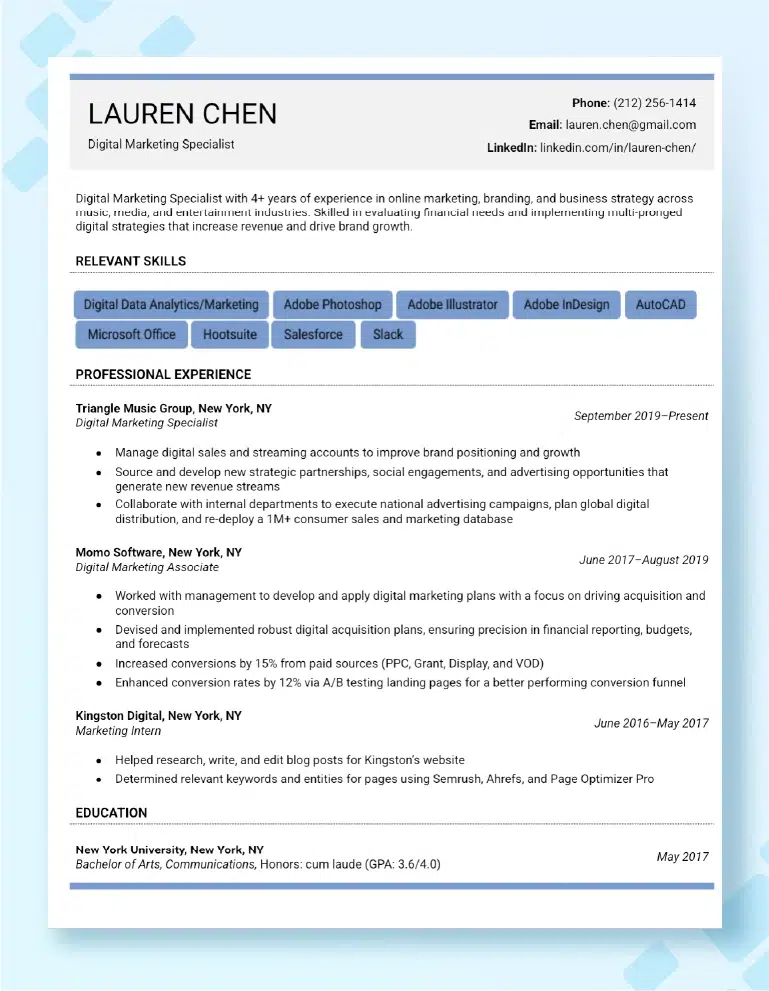
Recommended for freshers: Functional resume format
A functional resume format focuses on skills, tools, and projects instead of past roles. It helps you present what you can do, not what you have done. Start with a strong skills section, then move to education, internships, and certifications.
Other resume formats and when to use other them
- Reverse-chronological resume: Ideal if you’ve completed internships or have hands-on project experience.
- Hybrid resume: A balanced option if you want to combine key skills with short experience details.
Suggested structure
Header → Headline → Objective → Skills Section → Education → Projects or Internships → Achievements and Certifications → Additional sections (courses, clubs, volunteering)
Once you’ve decided on a resume format, it’s time to gather everything you’ll need before you start writing.
Prepare your information
Collect everything before you write. It keeps your draft focused.
Start by collecting:
- Contact information: phone number, professional email, city, and LinkedIn profile.
- Education details: degree, institution, year of graduation, and GPA (if strong).
- Skills: both technical and soft skills that align with the roles you want.
- Projects or internships: include academic, freelance, or personal projects.
- Certifications and achievements: online courses, hackathons, competitions, or volunteer work.
When your information is organized, writing your job winning resume becomes less about guessing and more about presenting your best work with impact.
If you are starting from a blank page, an AI resume builder can also help turn your education, projects, skills, and certifications into a more structured fresher resume.
Resume writing guide
Every professional resume starts with structure. Once you know what to include and where, the writing becomes less about filling space and more about communicating your value clearly.
Resume headline examples for freshers
Your resume headline is the first thing a recruiter reads after your name. It gives a quick snapshot of who you are and what roles you’re targeting. For freshers, it’s your chance to show intent and direction even before professional experience comes into play.
Avoid generic lines like “Hardworking fresher looking for opportunities”. Instead, be specific about your role and skills. A good headline in your resume can immediately make your profile feel sharper and help grab a recruiters attention.
How to write your headline
- Mention your target role clearly.
- Add two or three relevant skills or tools that fit that role.
- Include one proof point, like a project, certification, or academic focus.
💡 Pro tip: Keep your headline under one line. It should look neat under your name and give recruiters a reason to keep reading.
Formula to follow: Aspiring [Role] | [Skill or Domain] | [Tool or Proof Point]
Resume examples for fresher job seekers:
- Aspiring data analyst | Excel, SQL, Power BI | Final-year project on retail trends
- Entry-level software developer | Java, Python, React | Built an e-commerce website for college fest
- Marketing trainee | Social media, Canva, content writing | Managed college club promotions
- Finance analyst | Financial modeling, Excel | Internship at a CA firm
- HR coordinator | Talent sourcing, Excel | Volunteered in campus recruitment
- Operations trainee | Process improvement, MS Office | Certified in Lean Six Sigma
- Graphic designer | Photoshop, Illustrator | Portfolio of 10+ design projects
- Business analyst | Research, Excel, Tableau | Top 10 finalist in analytics competition
✅ Mini checklist
- The role is clearly stated
- Relevant skills match the job title and description
- Avoid buzzwords without proof
- Headline fits neatly in one line
Contact information
Your contact details sit right at the top of your resume and should look clean and professional. Many hiring managers shortlist or reject candidates based on how complete and clear this section is.
What to include in your resume template
- Full name
- Phone number (with country code if applying to national brands with multiple offices)
- Professional email ID (avoid casual ones like funnyguy99@gmail.com)
- City and state (you can skip your full address)
- LinkedIn profile link
- Portfolio or GitHub link (if relevant to your field)
Writing Style
Maintain a simple resume template and avoid over-styling, bold colors, or multiple fonts. Recruiters prefer resumes with information that’s simple to locate and read. Keep your resume template visually appealing, with a professional background, but ensure that all the information highlighting your internship and job experience is clearly presented.
✅ Example snippet
Ananya Sharma
📞 +91 98XXXXXX10 | ✉️ anxxxxxxxxma@gmail.com | 📍 Bengaluru, Karnataka
🔗 linkedin.com/in/anxxxxa | 💻 github.com/anaxxxma
Resume objective or resume summary statement
Your objective statement is where you define what you want to do and why you’re a good fit for the role. For fresher job seekers, this section in your resume replaces experience by showcasing the most relevant skills, enthusiasm, and alignment with the company’s goals.
The purpose of an objective statement
The intent is to show recruiters that you know what you want and that your skills and education match what the role demands. A well-written objective helps hiring managers immediately understand your direction and potential when they screen resumes.
💡 Pro tip: Keep your objective statement in your resume under three lines. Think of it as your elevator pitch — short, specific, and focused on your strengths.
How to write a career objective for a resume
Here are some pointers to keep in mind while writing your career objectives for a professional resume:
- Mention the target role or industry.
- Highlight one or two key interpersonal skills or academic strengths.
- Add a note on how you plan to contribute or learn in the role.
- Avoid generic goals like “seeking growth opportunities”. Instead, make it sound tailored to the position.
Examples of good objective statements for freshers
We’ve put together some examples to give you inspiration for your own resume:
- Motivated computer science graduate seeking a software development role to apply skills in Java and problem-solving to real-world projects.
- BCom graduate aiming for a finance analyst position where I can use Excel and financial modeling skills to support data-driven decisions.
- Detail-oriented marketing student passionate about content creation and digital campaigns, looking to contribute to a fast-growing brand.
If you’d like more examples, explore this detailed guide on Career Objective for Resume for Freshers to help you write a goal that truly reflects your ambitions.
Educational background
For most freshers, education is the strongest part of resume. Present it in a way that’s easy to scan and relevant to the first job you’re applying for.
How to list educational qualifications
- Start with your most recent qualification.
- Include the degree name, institution, university (if applicable), year of completion, and percentage or CGPA (if strong).
- Add relevant coursework, certifications, or academic achievements that strengthen your profile.
Example of how to write your educational qualifications:
Education
B.Tech in Computer Science, SRM Institute of Science and Technology, Chennai — 2024
CGPA: 8.6/10
Relevant Coursework: Data Structures, Machine Learning, Database Management Systems
Skills to mention in a resume
Deciding which skills to write in a resume can make or break your chances. Hiring managers often scan this section first to quickly gauge your strengths.
Include relevant technical and soft skills
Beyond your academic credentials, focus on skills you’ve practiced through projects, internships, or coursework.
- Technical skills: Tools, programming languages, or software knowledge.
- Soft skills: Communication, teamwork, adaptability, leadership abilities, and problem-solving.
💡 Pro tip: Show your soft skills through results. Instead of listing “communication,” you can write “Created content for college fest marketing campaign.”
Use keywords from job descriptions
Scan a few job postings in your field and note repeated terms — these are keywords recruiters and Applicant Tracking Systems (ATS) look for. Read the job description carefully and use them naturally across your headline, skills, and objective section.
Example skill lists
Listen below are some examples of technical and soft skills you could include in your resume as a recent graduate.
Technical Skills
- Languages: Python, Java, C++
- Web development: HTML, CSS, JavaScript, React
- Tools: Excel, Power BI, Tableau, Microsoft Word
- Software: AutoCAD, Figma, Photoshop
- Platforms: AWS, GitHub, Google Analytics
Soft Skills
- Communication and presentation
- Team collaboration
- Time management
- Analytical thinking
- Problem-solving
Hiring managers value candidates who keep learning and adding new tools to their profiles. If you want to level up, explore our list of Top 10 High Income Skills to Learn that can boost your career prospects.
Internships and projects
Even short internships or academic projects can show your initiative and problem-solving ability. Recruiters often look for proof that you’ve applied your knowledge in real or simulated settings.
How to describe internships and projects effectively
Focus on what you did and what impact it had. Use bullet points that start with action verbs like developed, created, organized, or designed. Keep it to 3–4 bullets per project.
Format tip:
Project Title / Internship Role
Organization or College Name | Month Year – Month Year
• Action verb + task + result
Sample project descriptions
- Data Analysis Project — Analyzed sales data using Excel and Power BI to identify key revenue drivers; presented insights to a panel of faculty.
- IoT Capstone Project — Designed a smart home prototype using Arduino sensors for temperature and light automation.
- Web Development Project — Built a responsive portfolio website using HTML, CSS, and JavaScript; implemented form validation and optimized page load speed for better user experience.
Achievements and certifications
This section gives recruiters quick evidence of your credibility and interests beyond academics. It helps potential employers see your commitment to learning and excellence.
Mention your awards and certifications concisely
List achievements that are recent, relevant, and role-specific. Mention the awarding body and year to add authenticity. Avoid overcrowding this section — choose quality over quantity.
How to prioritize what to include
- Certifications or awards that relate to your target role.
- Courses from credible platforms like Google, Coursera, or NPTEL.
- Hackathons, competitions, or volunteering recognitions that demonstrate initiative.
Examples
- Completed Google Data Analytics Certificate, 2024
- Winner, College Startup Pitch Competition, 2023
With all the core sections complete, let’s wrap it up with some general writing and formatting tips to make your resume look polished and professional.
Additional tips for writing your fresher resume
Your resume should look professional, read easily, and stay consistent throughout. The right structure and tone can make even a short resume feel polished.
Language and tone
Use simple, direct language. Avoid slang or flowery phrases. Write in active voice — for example, “Led a team of four for a college fest campaign” instead of “Was responsible for leading a team.”
Visual Appeal
Keep the resume simple and easy to look at. There are plenty of free resume templates available on websites like Canva. You can pick one of those customizable resume templates to help get you started.
Resume formatting tips
- Stick to one page if possible.
- Use a clean, readable font like Lato or Calibri (size 11–12).
- Maintain a simple resume consistent spacing and alignment.
- Use bullet points to break long paragraphs.
- Save your resume as a PDF before sending it.
Common mistakes to avoid
- Spelling or grammatical errors.
- Unprofessional email addresses.
- Irrelevant hobbies, extracurricular activities, or outdated certifications.
- Inconsistent formatting between sections.
Proofread your resume before submitting
Read it twice — once for content and once for formatting. Ask a friend or mentor to review it. A fresh pair of eyes can catch mistakes you might miss.
Make your resume ATS-friendly
Applicant Tracking Systems (ATS) scan resumes for keywords, so it’s important to create an ATS friendly resume for freshers. Use standard section titles (like “Educational Background,” “Skills,” “Experience”) and avoid heavy graphics or tables.
✅ Checklist for ATS-friendly resumes:
- Standard font and headings
- Keywords from job description
- No columns or decorative borders
- Saved as PDF or Word format
Secure your first job with MyCareernet
As a fresher, your resume might not yet have years of experience, but it can still leave a strong impression when written with focus and intent. Treat it as your launchpad into the professional world — one that opens doors to interviews, opportunities, and the first job you’re working toward.
Apply for jobs on MyCareernet — build your profile, explore roles tailored to your skills, and take the first confident step toward your career goals.
Frequently asked questions
Keep your resume to one page. Focus on the most relevant details — education, skills, projects, and certifications. Hiring managers prefer concise, well-organized resumes over lengthy ones.
Yes, but choose relevant or meaningful hobbies that show initiative or creativity. Extracurricular activities like blogging, volunteering, or participating in student clubs add value. Avoid generic hobbies like “watching movies.”
Be honest and keep it brief. If you used the time for learning, courses, or personal projects, mention that positively. Recruiters appreciate candidates who use their time productively.
Read each job description carefully and adjust your objective, skills, and keywords to match. Customizing your resume for every role shows focus and seriousness.
Keywords are crucial for getting through Applicant Tracking Systems (ATS). Use words that appear in job descriptions — like software tools, skills, or industry terms.
Read it aloud, check grammar tools like Grammarly, and ask a friend or mentor to review it. Always double-check email IDs, links, and dates before sending.
List your internship title, company name, and duration. Use bullet points starting with action verbs and focus on your contributions and learnings to convey your relevant experience.
A declaration is optional now, but if needed, keep it simple:
“I hereby declare that the information provided above is true to the best of my knowledge.”
Add your name, date, and signature at the end.

MyCareernet
Author
MyCareernet brings expert insights and tips to help job seekers crack interviews and grow their careers.